


Website redesign
Redesign your website while protecting valuable visibility
Your website no longer meets your needs: it looks dated, loads slowly or is difficult to update. A redesign makes sense. But an existing website has also built up value: pages that get found, links from other websites and content that works. I build the new website while carrying that organic value forward as carefully as possible.
- New foundations
- Carry existing value forward
- Design, development and SEO
- Work directly with Dries
At a glance
What does a website redesign involve?
A website redesign means replacing or fundamentally reworking an existing website: its design, technology, structure and content. Unlike a completely new website, something is already there. Some pages perform well in search; others achieve little. A redesign therefore starts by asking what should stay, what can improve and what can go.
At MadeByDries, one person does that work: Dries Nijs, web designer, developer and Organic Web Specialist. I design and build the new website while overseeing URLs, redirects and content to limit the risk of losing visibility.
This differs from a redesign where design, development and SEO sit with three separate providers: transferring the existing value can easily fall through the gaps. Here, it is part of the same plan from day one.
When
When should you redesign a website?
When it no longer serves your business, rather than simply because it has reached a certain age. These are familiar signs.
- The design is outdated The website no longer reflects what your business is today.
- It works poorly on mobile Text is too small, buttons are too close together or page layouts break.
- It is slow Heavy themes, large images or scripts that nobody uses any more.
- It is difficult to update Every change needs a workaround, or you no longer feel confident touching it.
- The technology is outdated The CMS, theme or plugins no longer receive updates.
- Your offering has changed New services no longer fit the old structure.
- It delivers little value Visitors arrive, but do not get in touch.
- It is not getting found The structure and content do not match what people search for.
The choice
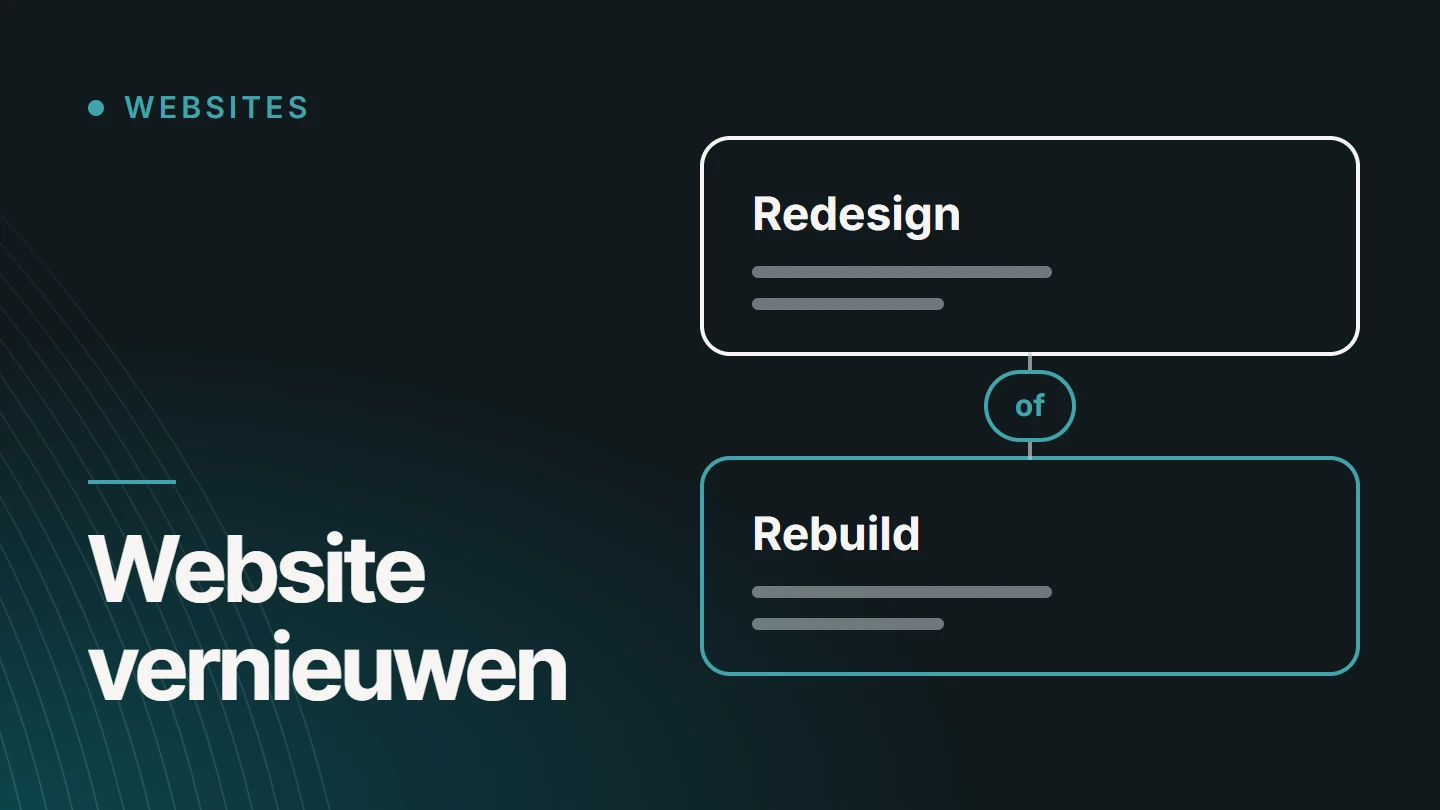
Redesign or rebuild: what is the difference?
Not every outdated website needs a complete rebuild. It depends on the underlying foundations.
A new look and layout
Redesign
The design and page layouts are refreshed on the same technical foundations. This makes sense when the CMS and structure are sound, but the appearance and user experience need updating.
New foundations
Rebuild
The website is rebuilt: structure, technology, design and content. This is needed when the technology is outdated, the structure no longer works or every change costs more than it delivers.
A cosmetic refresh on weak foundations rarely solves the problem. I can only determine which approach fits after reviewing the existing website. For a completely new website with no predecessor, see website development.
Inventory
What do you carry over to the new website?
Before designing, I take stock of what is there today. For each page, I assess whether it attracts visitors, gets found and still contains accurate content.
This makes a redesign a considered decision for each element, rather than discarding everything and starting again.
- Content that works Pages that generate visitors and enquiries retain their essential content.
- URLs with visibility Where possible, they stay the same. Where they change, they receive a redirect.
- Inbound links Links from other websites continue to lead to a relevant page.
- Metadata and structured data Titles, descriptions and markup are carried over and improved.
- Images and documents Anything still useful receives the appropriate format and a new place.
- What is deliberately removed Outdated or duplicate pages are merged or removed, with a carefully considered destination.
SEO
Limiting SEO risk during a redesign
A redesign changes many things at once: URLs, content, technology and internal links. Each can affect visibility. Retention cannot be guaranteed, but five steps help limit the risk.
01
Establish a baseline
Before making changes, I record the current position: which pages receive traffic and for which searches. When access to Search Console and analytics is available, I use that data.
02
Map the URLs
Every existing URL gets a destination on the new website: the same URL, a new URL or deliberate removal.
03
Set up redirects
Changed URLs permanently redirect to their new versions, directly and without chains.
04
Carry over content and metadata
The elements that made a page discoverable are not inadvertently lost during rewriting or reorganisation.
05
Check after launch
Check whether search engines are picking up the new structure, and address any issues.
Scope
Is a redesign the same as a migration?
Not quite. A redesign focuses on the new website, with transferring URLs and content included in the project. A migration is the move itself: to another domain, platform or URL structure. Google describes the steps in its documentation on site moves with URL changes.
For large websites, online shops or domain changes, SEO support for the move may be a separate workstream. We assess this together when defining the scope. You can read what that support involves on the page website migration. The steps are set out as a checklist in Website migration without losing rankings.
New foundations
What gets reassessed during a redesign
A redesign is an opportunity to revisit decisions made years ago.
Technology
WordPress or bespoke development for the new website?
For most business websites, WordPress remains the logical choice: you manage the content yourself and the website can grow with you. Read more at WordPress website development.
If the website has evolved into an application over the years, with accounts, calculations or integrations, bespoke development in React and Next.js often provides a better foundation. The technical side of the transition, from rendering to redirects, is part of my work on technical SEO.
More complex websites
Redesigning multilingual websites and online shops
Organic Web
Redesigning with Core. Code. Growth.
I treat design, development and visibility as one system. I call this Organic Web. Here is what that looks like during a redesign.
01
CORE.
First, understand what exists: the content, the data and what the website needs to do.
02
CODE.
Then build the new foundations: structure, design and technology, carrying existing value forward.
03
GROWTH.
After launch, check, refine and continue developing.
Projects
Websites I have designed and built
Three websites for which I handled design, development and SEO. Each case study explains what was built.
Website · GEO · SEO · Web design
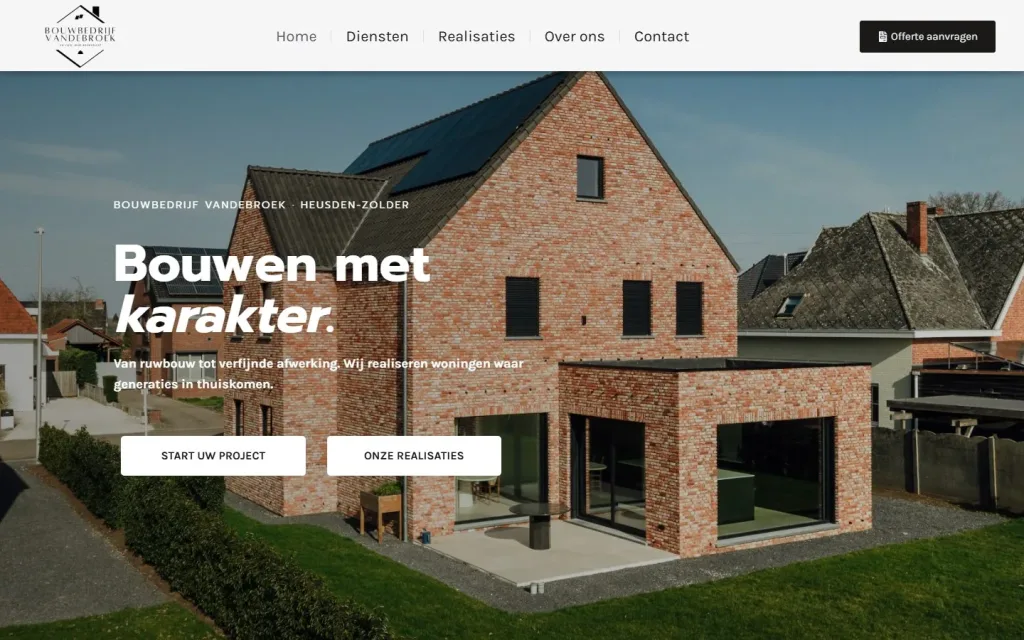
Bouwbedrijf Vandebroek
Website for Bouwbedrijf Vandebroek in Heusden-Zolder, with service pages for new builds and renovation, completed projects and a quote form with file upload.
- WordPress

Website · SEO · Web design
Andries Adventures
English-language website for adventure motorcycle tours, with tour pages showing prices and fixed departure dates, a tour finder and an enquiry form for each trip.
- WordPress
Website · SEO · Web design
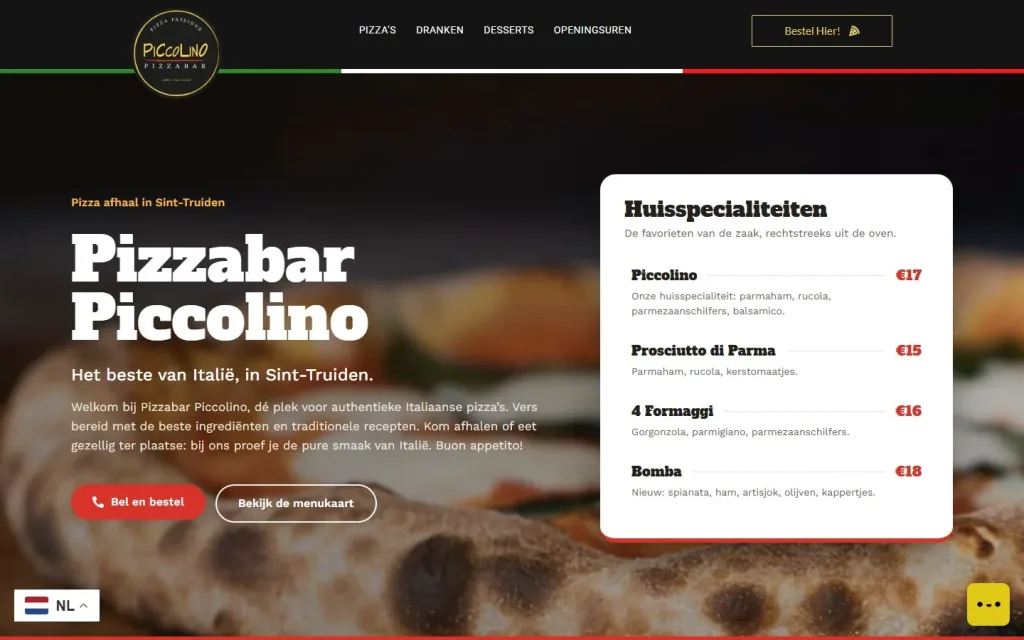
Pizzabar Piccolino
One-page restaurant website for Pizzabar Piccolino in Sint-Truiden, with the menu, photos and phone ordering for takeaway.
- WordPress
Pricing
How much does a website redesign cost?
A redesigned website follows the same project pricing as a new one: a compact website from € 1,495 excl. VAT, a business website from € 2,495 excl. VAT and a large-scale website from € 3,495 excl. VAT.
The additional work concerns the existing website: the inventory, URL mapping, redirects and content transfer. The larger and older the website, the more significant this work becomes. The final quote is based on the agreed scope. Detailed pricing is available in How much does a website cost?
- Size of the existing website The number of pages that need to be assessed and moved.
- URLs receiving traffic How many pages have visibility that needs to be carried forward.
- Content Retain, rewrite or create new content.
- Platform Stay on the same system or switch.
- Languages Each language version is migrated separately.
- Online shop Products, categories and order data.
- Integrations Forms, bookings or systems that need to keep working.
Why Dries
Redesign with someone who builds and protects visibility
- Direct contact You work with the person who takes stock, designs and builds.
- Design, development and SEO Redirects and structure are planned as part of the project, rather than added afterwards by someone else.
- WordPress and bespoke development I know both and choose what fits the new website.
- Honest about risk I cannot promise to retain rankings, but I can offer an approach that limits the risk.

About the specialist
Dries Nijs, Organic Web Specialist
I am Dries Nijs, a web designer, developer and Organic Web Specialist from Maasmechelen. I have been building websites since the 1990s, including their successors. For a redesign, I combine design, development and technical SEO so the new website builds on what the old one achieved. MadeByDries is the personal brand under which I work.
FAQ
Frequently asked questions about website redesigns
How often should you redesign a website?
There is no fixed interval. A well-built website can last for years when maintained. A redesign becomes relevant when the design, technology or structure no longer serves your business, rather than simply because a number of years have passed.
Will I lose my Google rankings if I redesign my website?
That risk exists, and nobody can eliminate it. It can be limited by recording what currently works, assigning every existing URL a destination, setting up redirects correctly and checking after launch. Fluctuations in the first few weeks are normal.
Can I have my existing website updated instead of redesigned?
Yes, when the foundations are sound. If the CMS is current and the structure is logical, a visual redesign or a series of targeted improvements is often enough. If the technology is outdated or the structure gets in the way, ongoing changes will eventually cost more than a rebuild.
How much does a website redesign cost?
A redesigned website follows the same project pricing as a new one: a compact website from € 1,495 excl. VAT, a business website from € 2,495 excl. VAT. Work on the existing website, such as the inventory and redirects, also contributes to the scope.
How long does a website redesign take?
That depends on the size of the existing website, how much content needs rewriting and how quickly text and images are ready. I agree a firm timeline once the scope is clear.
Do I need to change CMS?
Not necessarily. An up-to-date WordPress website can be redesigned on WordPress. A switch makes sense when the current system is no longer maintained, or when the website needs capabilities the system does not handle well.
What happens to my old URLs?
Every existing URL gets a destination. Where possible, the URL stays the same. Where it changes, a permanent redirect leads to the new page. Pages that are removed point to the most relevant successor or deliberately return a response indicating that they no longer exist.
Is your website ready for a redesign?
Send me the URL and tell me what no longer works. We can then discuss whether a redesign is enough or a rebuild makes more sense.