


Web Development & Web Apps
Node.js as a backend: when is it the right choice?
Node.js is an environment that runs JavaScript on the server instead of in the browser, and as a backend it is particularly suited to APIs, real-time features and web applications in which many users make short requests at the same time. For compute-intensive work, or when your existing systems and people are at home in a different language, another backend is often the more logical choice.
By Dries Nijs, Organic Web Specialist
Last updated: 19 November 2026
At a glance
Node.js as a backend: the short answer
The backend is the part of an application that runs on the server: the rules, the data and the checks on who is allowed to do what. With Node.js, you write that part in JavaScript, the same language as the interface in the browser. One language for both sides keeps a project manageable, especially for a small team or a single developer.
A Node.js backend is good at waiting: for a database, for another service, for a user to send something back. That waiting does not hold up the other requests. This makes Node.js a good fit for applications with many simultaneous, lightweight requests.
The right choice depends less on the technology than on the context: what the application needs to do, what is already running and who will maintain the code later.
The basics
What is Node.js and how does JavaScript work on the server?
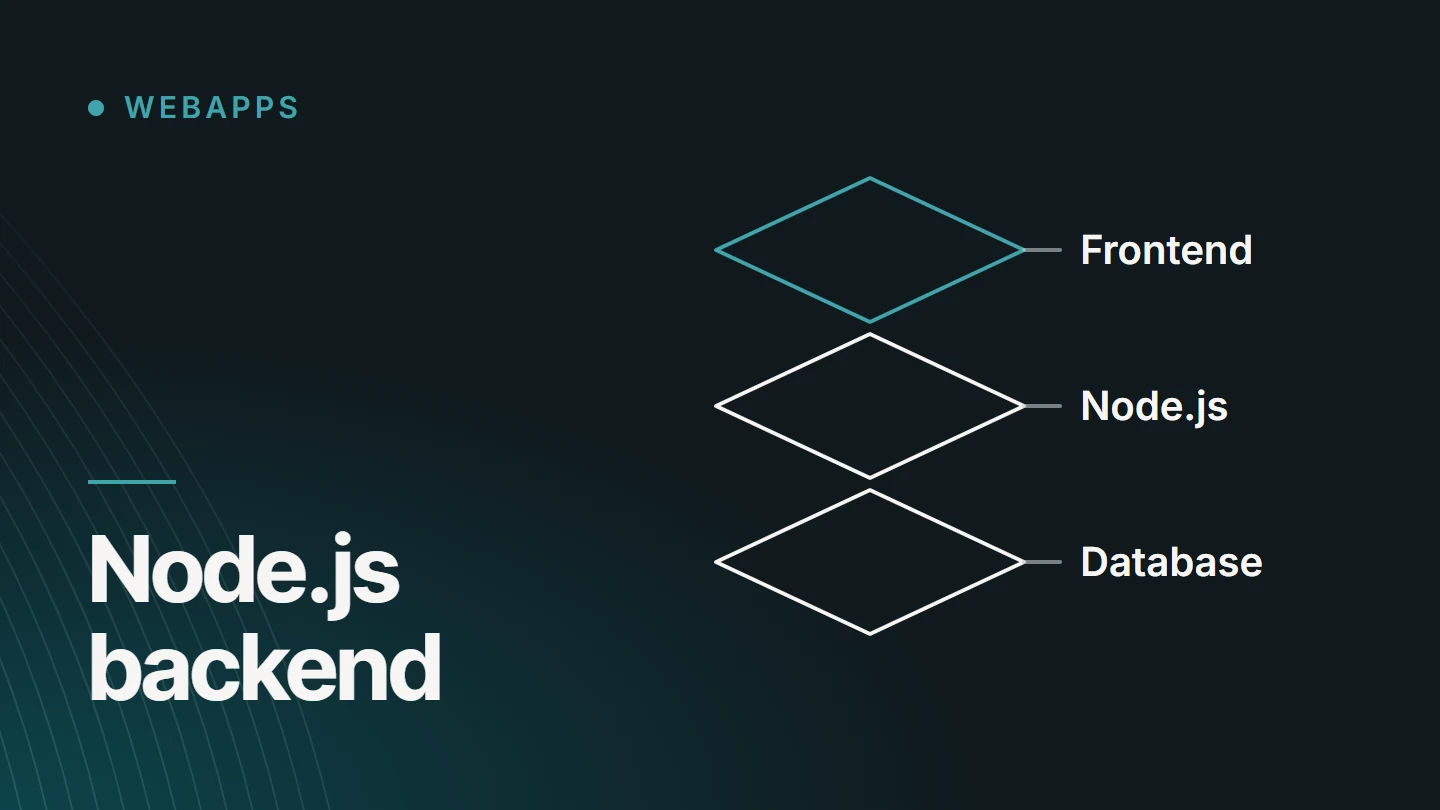
JavaScript was created for the browser. Node.js takes the language out of the browser and gives it access to what a server needs: files, the network and databases. Three concepts are enough to understand how that works. What the frontend, backend and database each do is explained in What is a web application?
What it is
The runtime
Node.js is neither a programming language nor a framework, but a runtime: the program that executes JavaScript code. It uses V8 for this, the JavaScript engine that is also in Chrome, and it is open source.
How it works
The event loop
In Node.js, JavaScript code runs on a single main thread. If it has to wait for a database or another service, Node.js carries on with the next request in the meantime and picks up the response as soon as it arrives.
The ecosystem
npm
Node.js comes with npm, a registry of packages you can use in a project, from a web framework such as Express to a library for dates. That saves work and requires discipline: every package is someone else’s code that you also have to keep up to date.
The official documentation and downloads are available at nodejs.org.
Tasks
What does a Node.js backend do?
Everything the user does not see, and that must not be left to the browser. The interface asks, the backend decides. How the exchange with other systems works is explained in the article on API integrations.
- Providing an API Receiving requests from the interface or from other systems and sending data back, usually as JSON.
- Running business logic Calculating a price, checking availability, changing a status: the business rules live on the server.
- Talking to the database Storing, retrieving and updating data, in a relational database or a document database.
- Checking logins and permissions Checking, for every request, who sent it and whether that user is allowed to see or do this.
- Calling other systems Starting a payment, having an email sent or fetching data from another package.
- Sending real-time messages Keeping an open connection with the browser, so that a notification or a change is visible immediately.
The stack
How do you combine Node.js with Next.js?
Next.js is a framework for React that also runs code on the server, and that server code usually runs on Node.js. So if you use Next.js, in practice you are already working with Node.js. The main question is where you put the backend logic.
01
Server logic in Next.js itself
Next.js can build pages on the server and has its own place for API routes. For an application with a limited backend, that is enough: one project, one place to maintain.
02
A separate Node.js server
As the backend grows, it often gets its own server, for example with a framework such as Express. Next.js then handles the interface and the public pages and fetches its data via the API.
03
The same language on both sides
The interface and the server are both JavaScript. Validation rules and data models can be shared, and a single developer can oversee the whole.
Suitability
When is Node.js a good choice as a backend?
Node.js is strong at work that mainly consists of waiting, and less so at work that mainly consists of computation. This table sets out the types of work that regularly come up in a web project.
| Type of work | Does Node.js fit? | Why |
|---|---|---|
| API for a web application | Yes | Many short requests that mainly wait for the database. |
| Real-time features | Yes | Chat, notifications or a dashboard that updates instantly: keeping connections open suits the way Node.js works. |
| Backend for React or Next.js | Yes | The same language as the interface, and Next.js itself runs on it. |
| Heavy computations | With reservations | Long-running computations keep the main thread busy. They need to be handled separately, or in a language designed for that. |
| Data analysis and machine learning | Rarely | The Python ecosystem is more developed for this. |
| Website that mainly consists of content | Not needed | A CMS such as WordPress provides content management out of the box. |
‘Yes’ here means: it suits the way Node.js works. It says nothing about how fast your application will be. That is determined by the architecture, the database and the hosting.
Alternatives
When is another backend the logical choice?
Choosing a technology also means choosing who maintains it. In these situations, Node.js is not the obvious choice, however technically suitable it may be.
- A backend is already running If the existing code is in PHP, Python, Java or C# and does what it needs to do, rewriting it is rarely worth the effort.
- The team knows a different language The people who will maintain the code in the coming years matter more than the advantages of a new technology.
- The project revolves around content A CMS in PHP, such as WordPress, can manage pages, articles and products without you having to build anything for it.
- The focus is on computation Image processing, simulations or large datasets require a language and tools designed for them.
Combining them is also possible: an existing backend stays in place, and a Node.js service takes over one task, such as real-time notifications or an integration. The trade-off between a CMS and bespoke development is covered in the article on WordPress or bespoke development.
Performance
Performance and scalability: what can you expect?
Node.js has a reputation for being fast. That is true for the kind of work it was made for, but a technology does not automatically make an application fast. A slow database query, an external service that responds late or a calculation in the wrong place: each of these weighs more heavily than the choice of runtime.
With Node.js, scaling is usually done by running multiple processes or servers side by side and distributing the requests across them. That works best when the backend itself keeps no state, and sessions and data are held in shared storage.
I do not give figures or guarantees here. You only know how many users an application can handle by measuring, with realistic data and on the environment it will run on.
My own platforms run on this technology: BM Jumpfun is built in React, Pelletkachelzorg in React and Next.js, and SEO Websites in React, Node.js and Express. How I use that stack as a service is explained on the page about React, Next.js and Node.js. If you are looking for a solution to a process rather than a technology, start with bespoke web applications.
FAQ
Frequently asked questions about Node.js as a backend
Is Node.js a programming language?
No. Node.js is a runtime: the environment that executes the code. The language you write in is JavaScript. Nor is it a framework. Frameworks such as Express are used on top of Node.js to set up a server more quickly.
Do I need Node.js if I use Next.js?
In practice, yes. Next.js uses Node.js to build the application and, in most set-ups, to run pages and API routes on the server. A separate Node.js server alongside it is only needed when the backend has to do more than fits in the Next.js project, or also has to serve other applications.
Which database do you use with Node.js?
Node.js does not impose a database. There are drivers for relational databases, which work with tables and SQL, and for document databases. The choice follows from the data: if it is closely interrelated, such as customers, orders and invoices, a relational database is the obvious choice.
Is Node.js suitable for a SaaS platform?
Yes, it is regularly used for that. Accounts, roles, subscriptions and an API are the kind of work Node.js is at home in. Whether it is the right choice for your product depends on what the platform needs to do and who maintains it. What such a platform involves is explained in What is a SaaS platform?
How much does a Node.js backend cost?
That depends on what the backend needs to do: the number of roles, the processes, the integrations and the security requirements. A general figure therefore does not exist. At MadeByDries, bespoke work is priced on request, after an initial definition of the scope.
Further reading
The related service
React, Next.js and Node.js as a service
Looking for someone to build a Node.js backend or take an existing codebase further? The service page explains how I work with React, Next.js and Node.js and how a project runs.

About the author
Dries Nijs, Organic Web Specialist
I am Dries Nijs, a developer from Maasmechelen. I have been building for the web since the 1990s. Today I develop web applications in React, Next.js and Node.js and websites in WordPress, and I choose the backend that suits the project. MadeByDries is the personal brand under which I work.
Not sure which backend suits your project?
Describe what the application needs to do and what is already running today. Then we will look at whether Node.js is the logical choice, or something else.