

Print & advertising
Print design that fits your brand, from business card to catalogue
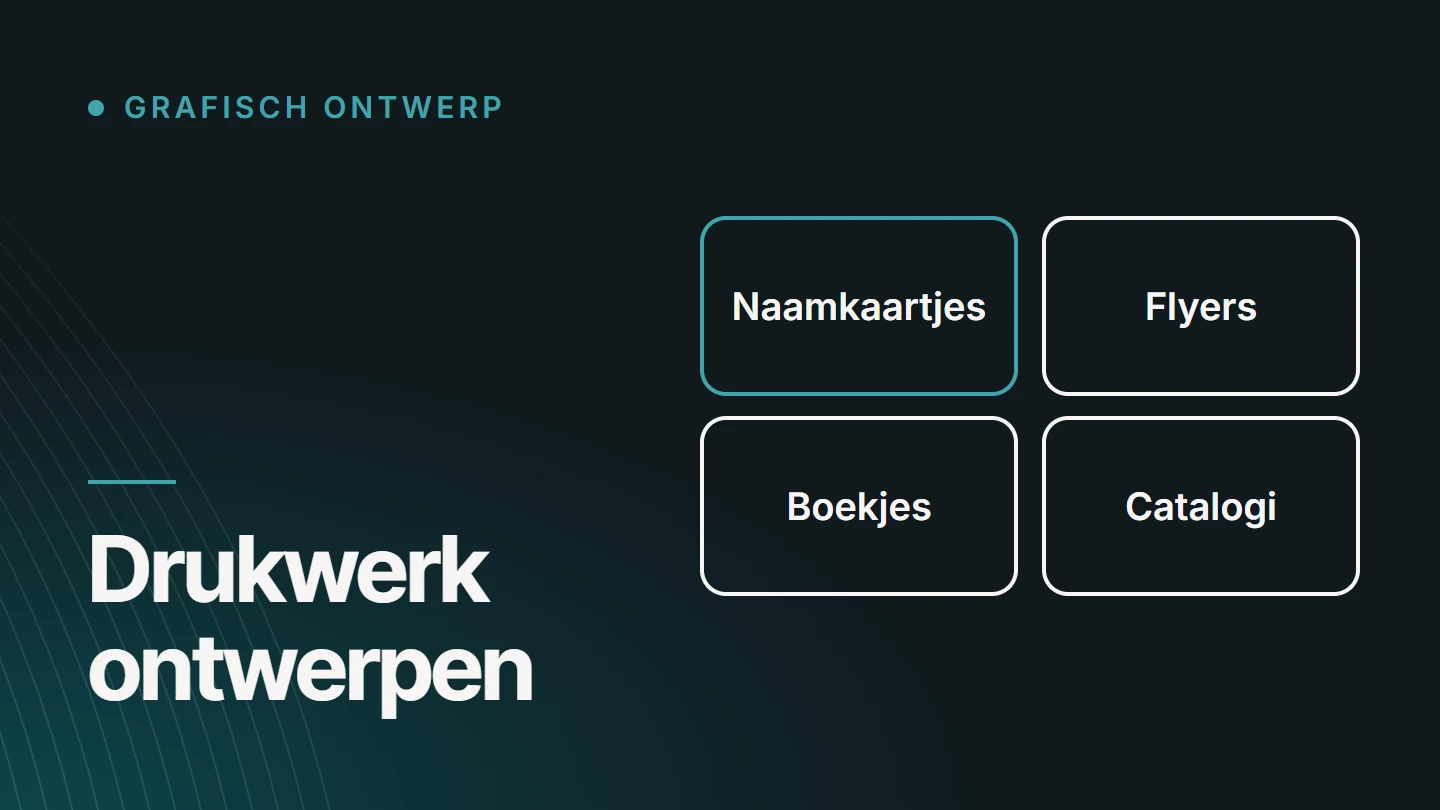
Business cards, a flyer or a catalogue are often the first thing from your business that someone holds in their hands. I design print and advertising in the same style as your logo and your website, and deliver every design print-ready: at the right size, in the right colours and ready for the printer.
- Delivered print-ready
- Business cards, flyers and catalogues
- In line with your brand identity
- Work directly with Dries
At a glance
What does print design at MadeByDries involve?
Print design at MadeByDries means that Dries Nijs, a web designer and developer from Maasmechelen, designs your business cards, flyers, leaflets, booklets, catalogues, posters and banners in the style of your brand. You get a design that fits your logo, your colours and your website, so that a customer recognises the same business on paper as online.
I deliver the design print-ready. Whether the printing itself is part of the assignment is agreed in advance in the quote. Print-ready means that the file can go to a printer without further processing: at the right size, with bleed and crop marks, in the right colour space and with sufficient resolution.
The price for print design starts from € 49 excl. VAT for Basic print. The final quote depends on the type of print, the size, the number of pages and the finish.
Services
The print and advertising I design
From business cards to a catalogue with dozens of pages: the medium differs, the question stays the same. What should someone understand at a glance, and what do they do next?
Advertising
What good advertising print has in common
Whether it is a flyer, a poster or an advertisement: advertising gets little time from the reader. In print design, I therefore apply the same principles every time.
- One message If you try to say everything at once, you say nothing. Every design gets one core message.
- Hierarchy First the headline, then the offer, then the details. The eye follows the order the design sets.
- Legibility A typeface and a contrast that work at the distance from which it is read.
- Recognisability Your logo, your colours and your visual language, just as they appear on your website.
- A next step Call, drop by, order or visit a page: the reader knows what they can do.
- White space Space around text and images is not wasted: it makes the message legible.
The choice
Do it yourself or have your print designed?
For simple print, there are good online tools and templates. Print design takes more than filling in a template as soon as it has to carry your brand.
Doing it yourself fits when
- it is a one-off print job, such as an invitation or a temporary promotion
- a template is enough and recognisability matters less
- you have the time to check the size, bleed and resolution yourself
- you already have a print-ready file and are only looking for a printer
Having it designed fits when
- the print has to match your logo, your brand identity and your website
- you want to reuse or extend the same design later
- there is a lot of content, as in a brochure or a catalogue
- the print goes to customers and shapes your first impression
If you are unsure, send me what you have. I will tell you honestly whether a template is enough or whether a bespoke design makes the difference.
Print-ready
What does print-ready mean?
Print-ready means that a design can go to the printer without further processing. A file that looks good on screen is not automatically print-ready. These points are part of every design I deliver, from business cards to a catalogue.
01
Size and bleed
The file is set to the exact finished size. If a colour or a photo runs right to the edge, the design gets an extra strip all the way round: the bleed. 3 mm is common. That way, no white edge appears when the cutting is a fraction off.
02
Crop marks and safe margin
Crop marks show the printer where the sheet will be cut. Text and logos stay a few millimetres away from that cutting line, so that nothing is lost.
03
CMYK instead of RGB
A screen mixes light in red, green and blue (RGB). A printing press mixes ink in cyan, magenta, yellow and black (CMYK). Not every screen colour exists in ink: bright colours often turn out slightly duller in print. That is why I set up print in CMYK. If a brand colour has to stay exactly the same, a printer can work with a spot colour, for example a Pantone colour.
04
Resolution
Photos need more pixels for print than for a screen. A common guide value is 300 dpi at the size at which the image is printed. I use a logo as a vector file, so that it stays sharp at any size.
05
PDF as the final file
The final file is a PDF in which the fonts are embedded and the bleed and crop marks are included. Every printer has its own artwork specifications: I take those as the starting point as soon as it is known where the job will be printed.
06
Final check
Before the file goes to the printer, you proofread the PDF one more time: names, telephone numbers, prices and dates. A mistake in printed work can no longer be corrected.
One coherent whole
Print that fits your brand identity and your website
Print rarely stands alone. Someone who receives your business card then looks up your website. Someone who reads your flyer scans the QR code or types in the address. In all those places, the same business has to be recognisable: the same logo, the same colours, the same typeface and the same tone.
If you have a brand identity, I start from it and convert the screen colours into colours for print. If you do not have one yet, it is wise to define your logo and brand identity first. Print without a fixed foundation looks different with every new assignment.
If your print refers to a page, that page is part of the design. A flyer about one promotion works best with a page about that same promotion. Because I also design and build websites (see website development), paper and screen fit together.
Preparation
What I need from you
A design is only as good as what has to go into it. This is what I need to get started. If something is missing, we look together at how to solve it.
- Logo Preferably as a vector file (.ai, .eps, .svg or PDF), so that it stays sharp at any size.
- Copy The final text, proofread. Correcting after the layout takes more time than before it.
- Images Photos in the highest resolution you have, with the rights to use them.
- Brand identity Colours, fonts and, if available, a style guide. If there is none, I start from your logo and your website.
- Size and medium What it needs to become: business cards, a flyer or a brochure, and at what size. If you do not know yet, I will help you think it through.
- Printer If you already have a printer, I would like to receive its artwork specifications.
How I work
Print design in five steps
From request to print-ready file in a fixed sequence, so that the design is right before it goes to the printer.
01
Request and medium
What the print has to do, who it is intended for and on which medium and at what size it will appear. The quote is based on that.
02
Content
You supply the copy, images and your logo. I check whether everything is usable for print and report what is missing.
03
Design
I work out a design in your brand identity and present it to you as a PDF.
04
Feedback
You pass on your comments and I incorporate them. How many rounds of corrections are included is agreed in advance.
05
Print-ready file
I deliver the design print-ready. Whether the printing itself is part of the assignment is agreed in advance in the quote.
Pricing
How much does print design cost?
At MadeByDries, print design starts from € 49 excl. VAT for Basic print: standard printed materials in common sizes. Promotional print, such as flyers, leaflets, posters and banners, starts from € 95 excl. VAT. Premium print, with a special finish, starts from € 295 excl. VAT. For Bespoke print, you receive a quote.
‘From’ is the price for an assignment with a limited scope within that package. The final quote depends on the type of print, the size, the number of pages and the finish. I deliver the design print-ready. Whether the printing itself is part of the assignment is agreed in advance in the quote. All MadeByDries prices are on the pricing page.
Basic print
For standard printed materials in common sizes.
From € 49 excl. VAT
- Polished, print-ready design
- Various sizes
- In line with your brand identity
Promotional print
For promotional material that stands out and persuades.
From € 95 excl. VAT
- Flyers and leaflets
- Posters and banners
- Other promotional material
Premium print
For high-quality printed materials with a special finish.
From € 295 excl. VAT
- Premium finish
- Bespoke design
- Personal advice
Bespoke print
For printed materials tailored entirely to your wishes.
Tailored quote
- Fully bespoke
- Personal advice
- Price after an initial conversation
What does ‘from’ mean? This is the price for an assignment with a limited scope within that package. The final quote depends on the type of print, the size, the number of pages and the finish. All prices exclude VAT.
- Type of print Business cards are different work from a brochure or a catalogue.
- Format Every size and every fold needs its own layout.
- Number of pages More pages mean more layout work and more checking.
- Finish A special finish requires an adapted file.
- Supplied material Copy, photos and a logo that are ready to use, or that still need editing.
- Variants Multiple languages, names or versions of the same design.
Why Dries
Why have Dries design your print?
- One designer for paper and screen Your print and your website follow the same line, because they come from the same person.
- Delivered print-ready You get a file a printer can work with, not a screen design that still has to be converted.
- Direct consultation You discuss your request and your comments with the person who makes the design.
- Honest about the limits If a template is enough, or if your request does not fit what I do, I will tell you before the quote.

About the specialist
Dries Nijs, Organic Web Specialist
I am Dries Nijs and I work from Maasmechelen as a web designer and developer. I have been building for the web since the 1990s and design websites, online shops and the print and advertising that go with them. MadeByDries is the personal brand under which I work. In print design, I start from the same question as with a website: what should someone understand at a glance?
FAQ
Frequently asked questions about print design
How much does flyer design cost?
At MadeByDries, flyer design falls under Promotional print, from € 95 excl. VAT. The final quote depends on the size, the amount of content, the supplied material and the number of variants. I deliver the design print-ready. Whether the printing itself is part of the assignment is agreed in advance in the quote.
What should a flyer always include?
One clear message in the headline, what you are offering and for whom, what the reader should do next, and how to reach you: your website, your telephone number or your address. For an event, add the date, the time and the place. Printed material distributed in Belgium usually also carries the name and address of a responsible publisher (verantwoordelijke uitgever, V.U.). Which notices are mandatory for your print is something you are best advised to check yourself: I do not give legal advice.
What is the standard size of a business card?
There is no single worldwide standard. In Belgium and the Netherlands, 85 × 55 mm is a common size for business cards, roughly the size of a bank card. In the United States, 3.5 × 2 inches is usual, which comes to about 89 × 51 mm. A different size is possible, but does not always fit in a card holder or wallet.
How can I design a business card myself?
You can design business cards yourself with the design tool of an online printer, with an online design program or with a template in a word processor. Pay attention to the right size, the bleed, a logo of sufficient quality and a font size that is still legible when small. If you want the card to match your logo and your website, a bespoke design pays off.
Can ChatGPT make flyers?
AI tools such as ChatGPT can write a text proposal and generate an image for a flyer. Such an image is usually a screen image: without bleed, not in CMYK and without your logo as a vector file. As a starting point or sketch of ideas, it is usable. For the printer, it still has to be built up into a print-ready file, and you are best advised to proofread the text in the image letter by letter.
Where is the best place to have business cards made?
That depends on the card you have in mind. An online printer with its own design tool is handy for a standard card. A local printer can advise on paper and finish. A designer is the right choice when the card has to match your brand identity and you want to reuse the design later. I design business cards and deliver them print-ready.
What is a print-ready file?
A print-ready file is a PDF that can be printed without further processing: at the exact finished size, with bleed and crop marks, in CMYK, with embedded fonts and images in sufficient resolution. A fuller explanation is in the section What does print-ready mean? on this page.
Can I supply my existing logo?
Yes. Preferably as a vector file (.ai, .eps, .svg or PDF), because it then stays sharp at any size. If you only have a small image, the logo sometimes has to be rebuilt first. We discuss that in advance. A new logo or a full brand identity falls under graphic design.
Which files do I receive on delivery?
The print-ready file, as a PDF. Whether you also receive the editable source files is agreed in advance in the quote.
Need print that fits your brand?
Tell me what you want designed, for example business cards, a flyer or a catalogue, and what you already have: a logo, copy or a brand identity.