


GEO & AI Search
GEO vs SEO vs AEO: what is the difference?
SEO (Search Engine Optimization) makes sure your pages are found in the search results. GEO (Generative Engine Optimization) makes sure AI systems use your content and represent your brand correctly in their answers. AEO (Answer Engine Optimization) is an older name for optimising for direct answers, and today it largely overlaps with GEO.
By Dries Nijs, Organic Web Specialist
Last updated: 19 November 2026
At a glance
GEO vs SEO vs AEO: the short answer
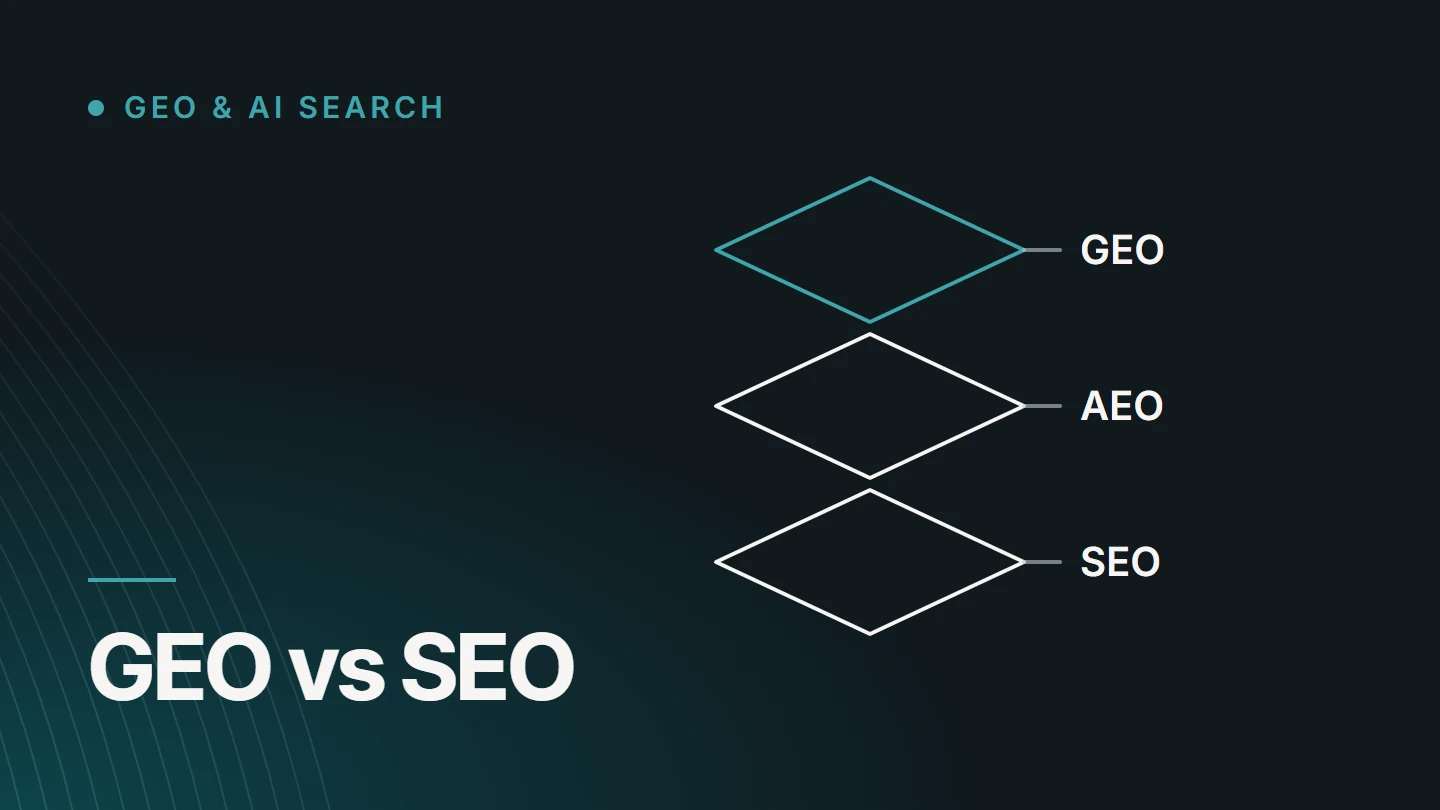
The three acronyms do not describe three different disciplines. They describe three places where someone gets an answer: a list of search results, a direct answer at the top or from a voice assistant, and a written-out answer from an AI system.
SEO is the foundation beneath all three. A page that is not crawled, understood and trusted does not appear anywhere. AEO and GEO add a different emphasis on top: what counts is not the position of a page, but whether a passage is chosen as an answer or as a source.
So you do not have to choose. The only question is where your audience gets its answers today, and whether your content is ready for that.
Comparison
SEO, AEO and GEO side by side
The table shows where each term places the emphasis. The columns are not mutually exclusive: what is in the first column is the prerequisite for the other two.
| Characteristic | SEO | AEO | GEO |
|---|---|---|---|
| In full | Search Engine Optimization | Answer Engine Optimization | Generative Engine Optimization |
| Where you become visible | The organic search results | Answer boxes, featured snippets and voice assistants | Answers from AI systems such as ChatGPT, Gemini, Perplexity and Google AI Overviews |
| What the user sees | A link with a title and a description | One short answer, often with one source | A composite answer drawn from multiple sources |
| What you work on | Technical quality, content, internal links and authority | Question-and-answer structure and short, precise definitions | Citable passages, a clear entity and external confirmation |
| How you track it | Rankings, impressions and clicks | Whether you hold the answer box | Whether and how you are mentioned for a fixed set of questions |
In practice, AEO and GEO overlap heavily. Where an answer box gives way to a generated answer, the work that used to be called AEO largely coincides with what is now called GEO.
The terms
What each term means exactly
Five names you come across interchangeably, with what they do and do not say.
01
SEO
Search Engine Optimization: everything that ensures search engines can find, understand and show your pages for a relevant search. The result is a place in a list.
02
AEO
Answer Engine Optimization: structuring content so that a system can extract one direct answer from it. The term emerged around featured snippets and voice assistants.
03
GEO
Generative Engine Optimization: setting up your website and the information about your brand so that AI systems can retrieve, understand and use them as a source when they write an answer.
04
LLMO
Large Language Model Optimization: another name for the same goal as GEO, with the emphasis on the language model behind the system rather than on the answer it generates.
05
AI SEO
The informal umbrella term. Sometimes it means GEO, sometimes the use of AI tools in ordinary SEO work. With this term, always ask which of the two is meant.
Language
Why these abbreviations cause confusion in Belgium
Two of the three abbreviations already have a different, much better-known meaning in Dutch. Anyone who uses the term in a quote or a meeting without explanation risks half the table thinking of something else.
AEO is a customs term for most Belgian businesses: Authorised Economic Operator, the status of an authorised operator in international trade. In my measurement of Belgian search results in November 2026, the AI Overview for the query ‘aeo’ explained the abbreviation as that customs status, not as Answer Engine Optimization. The questions Google showed alongside it were also about permits and certification.
Geo is the prefix for anything to do with geography and location. Anyone who types ‘geo’ sees maps, geography and surveyors. I explain the term itself in What is GEO (Generative Engine Optimization)?.
That is why I write out both abbreviations in full the first time I use them, and in conversations with clients I prefer to talk about the goal: being mentioned and accurately described in AI answers.
Overlap
What do SEO, AEO and GEO have in common?
More than the abbreviations suggest. Google writes in its documentation on AI features and your website that the same basic principles apply to its AI answers as to the regular search results.
- Accessible pages What cannot be crawled and read does not exist for any system.
- Content that answers a question A clear answer to a real question works in a search result, in an answer box and in an AI answer.
- A clear structure Headings, paragraphs and lists that show what belongs with what.
- Reliability A recognisable publisher, facts with a source and content that is up to date.
- Structured data Markup that tells machines what a page describes.
- Speed and stability A slow or glitchy page is crawled less effectively and read less readily.
Difference
What really changes with GEO?
Three things shift when the answer is generated rather than listed.
From page to passage
The unit
A search engine ranks pages. An AI system extracts pieces from them. A paragraph therefore needs to make sense on its own, with the subject in the sentence itself.
From website to entity
The publisher
A system that writes about you needs to know who you are. Your name, your description and your details should be the same everywhere, on your website and beyond.
From ranking to mention
The measurement
There is no fixed number one position. The same system can answer the same question differently. So you track a series of questions over time, not a single figure.
What does not change: nobody can guarantee a mention, just as nobody can guarantee a position in Google.
Choice
What do you need: SEO, GEO or both?
For almost every business, the answer is: the foundations first, then the extension. These two lists help you work out where you stand.
Start with SEO when
- your most important pages are not indexed, or are indexed poorly
- your website is slow or hard to use on mobile
- your services do not have their own page
- titles, headings and internal links do not follow a clear structure
Add GEO when
- the technical foundations are in order
- customers ask an AI system about your name or your service
- an AI system describes your business incorrectly or incompletely
- decisions in your market are mostly made through questions and comparisons
If you are looking for someone to take care of the foundations, the page SEO consultant explains how I approach that. For visibility in AI answers, see the page GEO & AI SEO.
Misconceptions
Three misconceptions about these terms
- “GEO replaces SEO.” No. AI systems largely draw their sources from pages that are also easy to find in search engines.
- “Every acronym is a separate service.” No. It is the same work on the same website, with a different emphasis.
- “AI needs a different kind of content.” No. Clear, honest and well-structured content works for people, for search engines and for AI systems.
Anyone who wants to sell you three separate projects for three acronyms is mainly selling acronyms.
FAQ
Frequently asked questions about GEO, SEO and AEO
What is the difference between SEO and AEO?
SEO focuses on a position in the search results. AEO (Answer Engine Optimization) focuses on the single direct answer that a search engine or voice assistant shows. AEO builds on SEO: without a page that is easy to find, your answer will not be chosen.
What is the difference between AEO and GEO?
AEO targets one short answer from one source, such as a featured snippet. GEO targets answers that an AI system compiles from multiple sources. The work overlaps heavily, and in practice GEO is the term most commonly used today.
Does AEO or GEO replace traditional SEO?
No. They are extensions built on the same foundation. A website that is technically sound and has solid content for search engines has already done most of the work for AI answers.
What does AEO mean?
In online marketing, AEO stands for Answer Engine Optimization. In the Belgian business world, AEO is mainly known as Authorised Economic Operator, a customs status. That is why you should always write the term out in full once.
Is GEO better than SEO?
Neither is better than the other; they do different things. SEO brings visitors through the search results. GEO makes sure you are mentioned and described correctly in AI answers. Which of the two delivers more depends on how your audience searches.
What is LLMO?
LLMO stands for Large Language Model Optimization. It is another name for what is also called GEO: setting up your content and your brand so that language models can use them correctly.
Further reading
The related service
GEO & AI SEO as a service
Whatever the acronym, the work starts with looking at how AI systems describe your brand today. The service page explains how that process works.

About the author
Dries Nijs, Organic Web Specialist
I am Dries Nijs, a developer and SEO consultant from Maasmechelen. I have been building websites since the 1990s, and today I combine development, SEO and GEO in one approach. MadeByDries is the personal brand under which I work.
Not sure where to start?
Describe your website and your goal. I will tell you whether the foundations need attention first, or whether GEO is the logical next step.