


What are backlinks and when do they help?
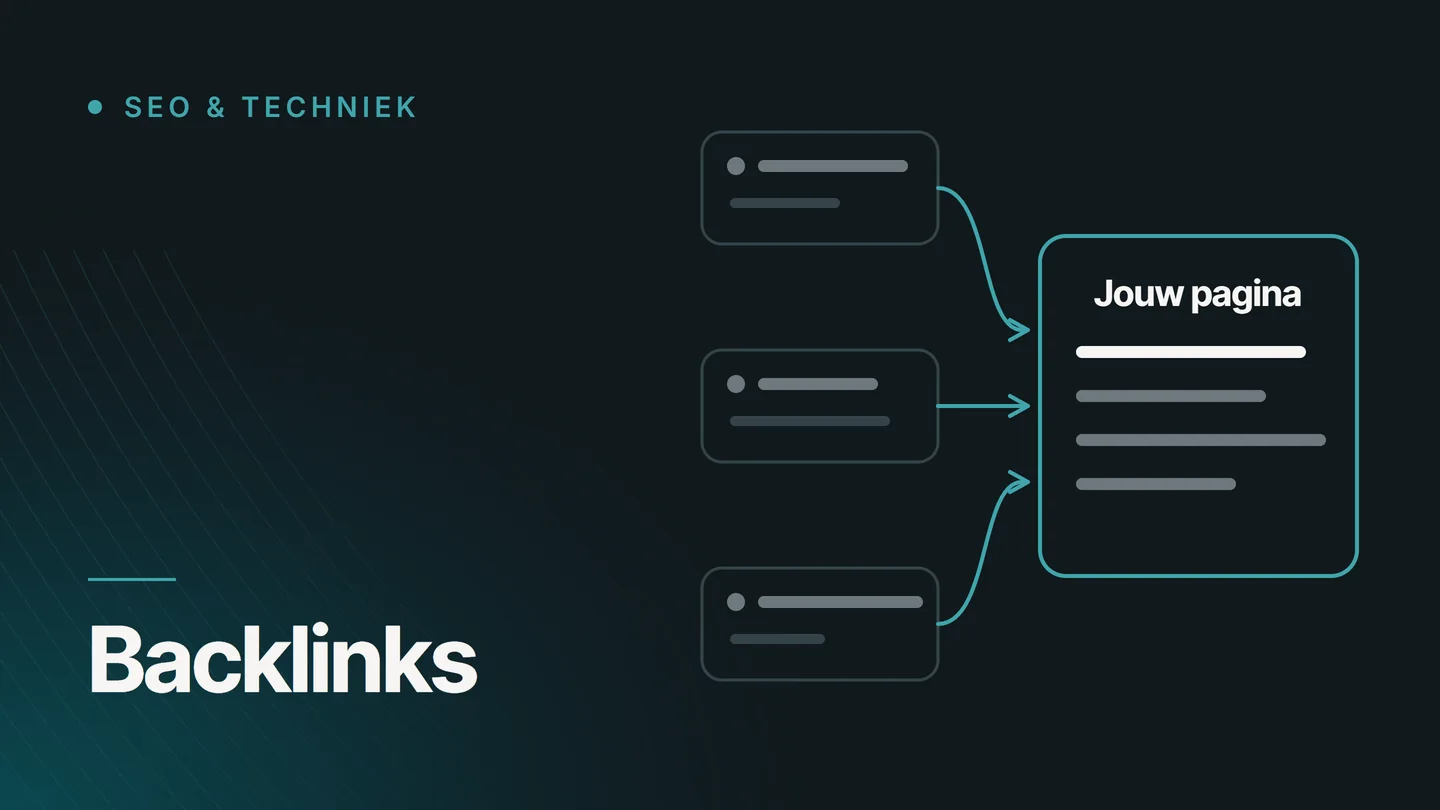
Backlinks are links on other websites that point to a page on your website. Search engines use them to discover new pages, and as one of the signals for judging how relevant a page is. They help most when they come from websites that fit your subject, and when the page they point to itself gives a good answer.
By Dries Nijs, Organic Web Specialist
Last updated: 20 November 2026
At a glance
What are backlinks? The short answer
A backlink is a reference: someone else thought your page worth mentioning and links to it. For a visitor, that is a way through to your website. For a search engine, it is a clue to what your page is about and who is referring to it.
Links are not the only thing that counts. Google calls them one signal among many, and a link does not make a weak page any better.
Not every link helps. Links made purely to rank higher fall under what Google calls link spam. That is why this article also covers the links you are better off without.
Mechanics
What does Google do with a backlink?
Two things, according to Google’s documentation on links: Google uses links to find new pages, and as a signal when determining the relevance of pages.
The best-known system behind this is called PageRank. In its guide to ranking systems, Google describes it as one of its core systems from the day the search engine launched, and one that has changed a great deal since. The same guide describes sixteen other systems besides, so links are one signal among many.
What that means for you: a link is a recommendation that counts, not a dial you can turn to set your position. Building links is one part of the work of an SEO consultant, alongside the technical side and the content of your website.
Quality
What makes a backlink valuable?
As a rule, not the number. A link from a website that writes about the same subject says more than a string of links from pages that have nothing to do with it.
01
The source
A website that is itself trustworthy and covers your field. A trade journal, a supplier or a trade association carries a different weight from a random page of links. How trustworthiness is assessed is explained in the glossary under E-E-A-T.
02
The placement
A link in the body text, at the point where it takes the reader further. According to Google, the words before and after the link matter too.
03
The anchor text
The clickable words tell reader and search engine what the page is about. Short and descriptive works better than ‘click here’, and better than a string of keywords.
04
The target page
The link points to a page that exists, is in the index and gives the answer itself. If a page moves, forward the old address with a 301 redirect; otherwise the link leads to an error page. More in Website migration without losing rankings.
Types
Dofollow, nofollow, sponsored and ugc: what types of links are there?
For each link, a website can indicate how it relates to the page it links to. That is done with a small piece of code, the rel attribute. Google describes three values; a link without any such label is known in practice as dofollow.
| Type | What the website is saying | Where you see it |
|---|---|---|
| Ordinary link (dofollow) | We link to this page without reservation | In an article, when citing a source, when naming a partner |
Sponsored (sponsored) | This link was paid for, or it is advertising | Advertisements and paid placements |
From visitors (ugc) | This link comes from a visitor, not from us | Comments and forum posts |
Nofollow (nofollow) | We do not want to be associated with this page | Where the other two do not apply |
Google generally does not follow links labelled in this way. Visitors can still click on them, so a nofollow link can bring you customers too.
Check it yourself
How do you check your own backlinks?
Free of charge, in Search Console. The Links report shows who links to your website. It is a sample, not a complete list, and it does not say whether a link is nofollow.
01
Open the Links report
You will find it in the Search Console menu. Links from other websites and links within your own website are listed separately.
02
Look at your most linked pages
Which pages attract the most links? If it is only your homepage, you know what to work on.
03
See who links most often
The list of websites shows who links to you. Do you recognise them, and do they fit your line of work?
04
Look at the link text
Which words do others use to link to you? Your business name and ordinary descriptions should be at the top.
05
Compare with a second source
Tools such as Ahrefs and Moz show more links, with scores of their own such as DR and DA. Those are estimates made by those companies, not figures from Google.
Building
How do you get backlinks?
By having something others want to link to, and by using the places you are already entitled to. That takes time, not money.
- Suppliers and partners Businesses you work with often list their customers or distributors. Ask to be included, with a link to the page that fits.
- Trade association and industry federation If you are a member, you will usually appear in a list of members. Check that your entry is correct and links to your website.
- Customers and projects A customer who writes about the result, or an architect who shows the project, points to whoever carried out the work.
- Local press and local authority An opening, an anniversary or an eye-catching project can become local news, with a link to your website. More about being found locally on the local SEO page.
- Content that answers a question A clear explanation, a sample calculation or a checklist gets cited by people writing about the same subject.
- Your own profiles Your Google Business Profile and your social media profiles are not recommendations from others, but they do make clear who you are. See Entity SEO.
If you do not have the time for that, you can have it done for you. I offer link building myself in fixed packages: the links are placed by hand, in places that suit your website, to build authority. Beforehand, I check whether your website is ready for it.
Risk
Which backlinks are a risk?
- Buying or selling links to rank higher. Google counts that as link spam, even when the payment is made in products or services. Advertising and sponsorship are allowed, as long as the link is marked as sponsored or nofollow.
- Automatically generated links. Programs or services that create links for you.
- Excessive link exchanges. ‘Link to me and I’ll link to you’, or partner pages that exist only for that purpose.
- Links in low-quality directories. Business directories and bookmarking sites that nobody visits to look for anything.
- The same link in every footer. Widely distributed links in the footers or templates of all sorts of websites.
- Comments with a link full of keywords. Forum posts and comments whose only purpose is to leave a link behind.
These examples come from Google’s spam policies. A website that breaks them may rank lower or disappear from the results. Google says it can assess most links on its own; the disavow tool is intended only for those with a large number of artificial links that have led, or are likely to lead, to a manual action. With any offer, ask how the links are placed, and on which websites.
Nuance
When do backlinks help, and when do they not?
Links reinforce what is already there. They do not solve a problem that lies in the website itself.
They help when
- your pages are in the index and technically in order;
- the page the link points to answers one search query clearly;
- competitors with similar content already have many links;
- your website is new and nobody mentions it yet.
They do not help when
- Google cannot read your pages or does not index them: that is a job for technical SEO;
- the content is thin, or the same question is answered on three pages;
- all the links point to the homepage while the visitor is looking for a service;
- you expect a fixed position or a fixed timescale.
If you are not sure where you stand, work through the SEO checklist first: links do not come up there until step 5. If you do not know where the problem lies, an SEO audit will find out. For visibility in AI answers, mentions on other websites can also help you to be recognised as a source; that is part of GEO & AI SEO.
FAQ
Frequently asked questions about backlinks
How many backlinks do you need?
There is no set number. It depends on your market: for a local search with little competition, a few good links can be enough, while in a crowded market the pages at the top often have many more. Look at who is at the top today for your search query, not at a fixed number.
Are nofollow links worthless?
No. Google generally does not follow them, but visitors can still click on them. A nofollow link on a website your customers visit can bring in more than an ordinary link on a page nobody reads.
What is the difference between a backlink and an internal link?
A backlink comes from another website. An internal link connects two pages of your own website. Internal links are in your own hands: Google recommends that every page you consider important gets at least one link from another page on your website.
Can you have bad backlinks removed?
You can ask the owner of the other website to take the link down. Google also has a disavow tool, but says itself that most websites do not need it and that using it incorrectly can harm your results. Use it only where there is a large number of artificial links and a manual action.
How do I know who links to my website?
In Search Console, in the Links report. You can see which websites link to you most often, to which pages and with which words. The report is a sample and may include links that have since disappeared.
What is good anchor text?
A short, descriptive text that says what the reader will find behind the link. Your business name, the name of a service or an ordinary description is fine. A string of keywords works against you: Google explicitly names optimised anchor text in paid articles as an example of link spam.
Further reading
The related service
Link building as a service
Want to have links built for you and know whether your website is ready for it? On the service page, you can read what the three packages include, and what you can honestly expect from them.
About the author
Dries Nijs, Organic Web Specialist
I am Dries Nijs, an SEO consultant and web developer from Maasmechelen. I have been building websites since the 1990s, and being found in search has always been part of that. MadeByDries is the personal brand under which I work.
Want to know whether links are your next step?
Let me know which website it concerns and which pages you want to strengthen. I will tell you honestly whether links make sense right now, or whether you would do better to work on the website itself first.