


Website & Strategy
European Accessibility Act: what does it mean for your website?
The European Accessibility Act (EAA) is a European directive intended to make certain consumer products and services accessible to people with disabilities. The rules have applied since 28 June 2025. For websites, the directive is mainly relevant if you sell online to consumers. Not every website falls under it, and this article is not legal advice.
By Dries Nijs, Organic Web Specialist
Last updated: 19 November 2026
At a glance
What does the European Accessibility Act mean for your website? The short answer
If you sell products or services to consumers through your website, there is a good chance that your online shop or ordering process falls under the rules. The directive explicitly mentions e-commerce services. There are exceptions and transitional rules, including for microenterprises.
A website that only provides information, and where nothing can be ordered or contracted, is not an e-commerce service within the meaning of the directive. Government websites fall under other, older rules.
Whether you fall under the rules therefore depends on what you offer, to whom, in which sector and how large your business is. You can read about the Belgian implementation and the exceptions at the FPS Economy. If you are unsure about your own situation, consult a lawyer.
The directive
What is the European Accessibility Act?
The European Accessibility Act is the common name for Directive (EU) 2019/882 on the accessibility requirements for products and services. In Dutch, it is also referred to as the Europese Toegankelijkheidswet. The aim is that people with disabilities can use the same products and services as everyone else, under the same rules in all member states.
A directive does not apply directly: each member state transposes it into its own legislation. Member states must apply those rules from 28 June 2025. Belgium has also transposed the directive. For e-commerce services and consumer banking services, the rules are set out in the Code of Economic Law, and compliance is supervised by the Economic Inspection of the FPS Economy . For other sectors, such as transport or electronic communications, other authorities are responsible.
The EAA is different from the older directive on the accessibility of public sector websites and apps (Directive (EU) 2016/2102). That one applies to the public sector. The EAA targets businesses that place certain products and services on the market.
Scope
Which services and products fall under the EAA?
The directive does not apply to everything. It lists which services and products are covered. This is the list in broad terms.
Consumer services
- e-commerce services, such as online shops and online ordering or booking processes
- consumer banking services
- electronic communications services
- services providing access to audiovisual media
- elements of passenger transport, such as websites, apps, tickets and travel information
- e-books and the software for reading them
Products
- computers and their operating systems
- smartphones and similar devices
- self-service terminals, such as payment terminals, ATMs and ticket machines
- e-readers
- equipment for accessing audiovisual media
For anyone having a website built, the first item is the most important. In the directive, an e-commerce service is a service provided at a distance, through websites or mobile applications, by electronic means and at the request of a consumer, with a view to concluding a consumer contract.
Your situation
Does your website fall under the EAA?
The table gives an initial indication, not a definitive answer. The exact boundary depends on your activity and on the Belgian rules.
| Situation | Initial assessment | Why |
|---|---|---|
| Online shop for consumers | Yes, unless an exception applies | The directive explicitly mentions e-commerce services |
| Microenterprise with an online shop or ordering process | In Belgium: additional transition period until 28 June 2030 | Fewer than 10 employees and an annual turnover or balance sheet total of no more than €2 million (source: FPS Economy) |
| Website that only provides information | In principle, not an e-commerce service | No consumer contract is concluded online |
| Online appointments, bookings or quotes | Depends on the situation | It depends on whether a contract with a consumer is concluded online |
| Sales to businesses only | Probably not | The services listed are services to consumers |
| Government website | Other rules | Directive (EU) 2016/2102 applies here |
If you operate in one of the other sectors on the list, such as banking services or transport, additional sector-specific requirements apply. Those are beyond the scope of this article.
Small businesses
Does the EAA also apply to small businesses?
The directive itself makes a distinction: it exempts microenterprises that provide services from the accessibility requirements (Article 4(5)). A microenterprise is an enterprise with fewer than 10 employees and an annual turnover or an annual balance sheet total of no more than €2 million.
Belgium has arranged this differently. The FPS Economy states that microenterprises have an additional transition period until 28 June 2030 to make their services accessible. That is a postponement, not a permanent exemption. So as a small Belgian online shop, do not assume that the rules will never apply to you.
In addition, the directive contains transitional measures until 28 June 2030 for certain existing situations, for example for service contracts concluded before 28 June 2025.
Which rule applies to your business depends on your activity, your sector and your size. Check your headcount and turnover, read the current information from the FPS Economy and, if in doubt, have your position checked. A business that grows will eventually no longer meet the definition of a microenterprise.
Requirements
What is expected of a website?
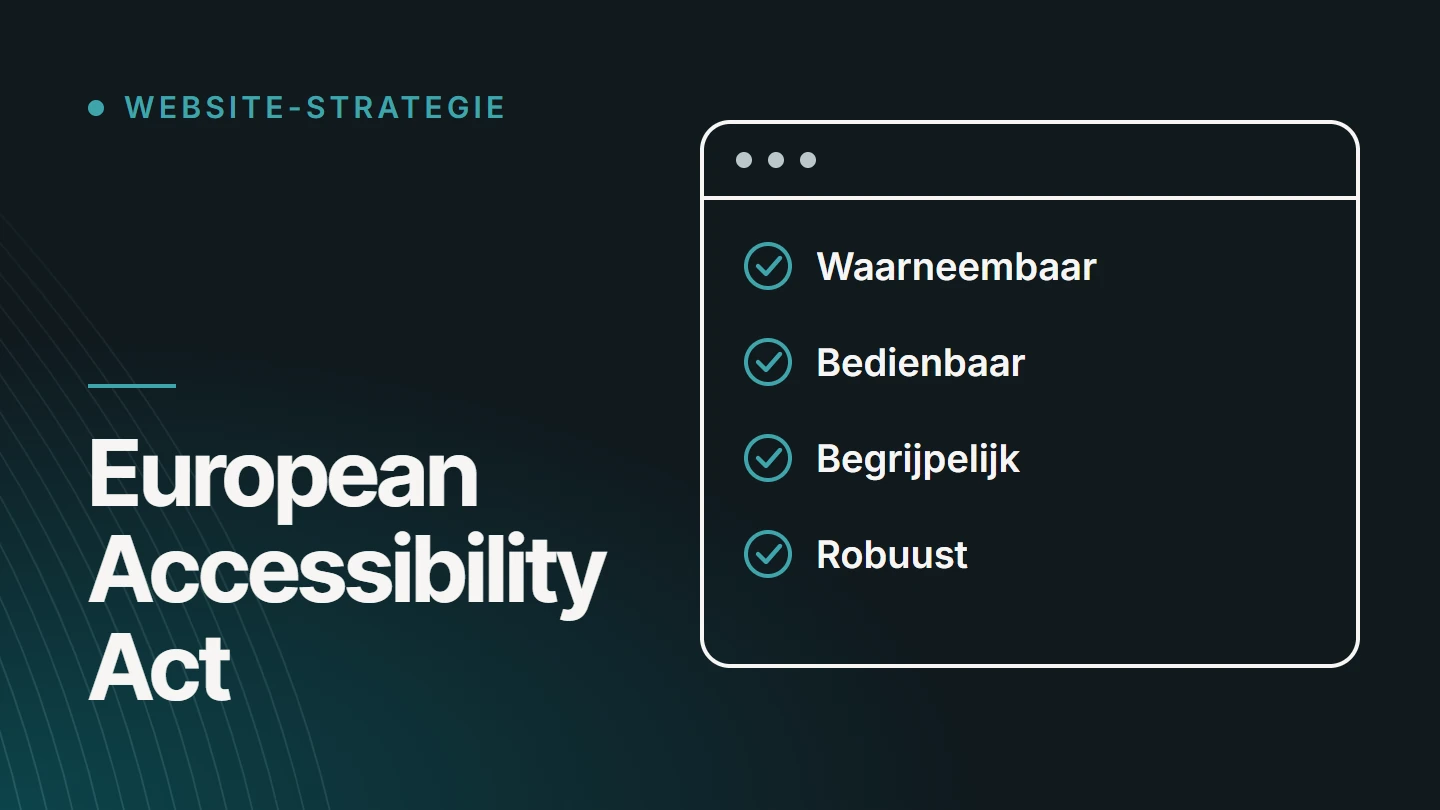
The directive describes what a service must be able to do, not which technology to use. Websites and apps must be perceivable, operable, understandable and robust. In practice, this is done using the European standard EN 301 549, which for websites aligns with WCAG, the Web Content Accessibility Guidelines, at level AA.
- Perceivable Text with sufficient contrast, a text alternative for images and captions for video.
- Operable Everything works with the keyboard, and the focus is always visible.
- Understandable Forms with clear labels and error messages that say what is going wrong.
- Robust Correct, semantic HTML that assistive technology such as screen readers can interpret.
- Structure A logical heading structure and a language specified in the code.
- Scalable The page remains usable when someone zooms in or enlarges the text.
- The entire journey For an online shop, this also includes the shopping basket, identification, payment and confirmation.
- Accessibility information Service providers explain how their service meets the requirements, for example in an accessibility statement.
Many of these points are also simply good craftsmanship. A clear heading structure, text alternatives and semantic HTML help search engines just as much as visitors using a screen reader.
Exceptions
What exceptions does the directive provide for?
Besides the arrangement for microenterprises, the directive has two general exceptions. The requirements do not apply insofar as they would require a fundamental alteration of the service or impose a disproportionate burden. Anyone invoking these must carry out the assessment themselves and be able to present it. So it is not a free pass.
For websites and apps, the directive also excludes certain content:
- pre-recorded video and audio published before 28 June 2025;
- office file format documents published before 28 June 2025;
- online maps, provided that essential information for navigation is offered in an accessible way;
- third-party content that the provider does not fund, develop or control;
- archives containing content that is no longer updated after 28 June 2025.
Whether any of these exceptions applies to you is a legal question. This overview helps you recognise them, not apply them yourself.
Misconceptions
Four misconceptions about the EAA
- “Every website now has to comply with WCAG.” The directive applies to the listed services and products, not to every website.
- “A plugin or overlay will solve it.” An accessibility toolbar on top of an inaccessible website does not fix the underlying code. Accessibility lies in the design and the build.
- “It is a one-off check.” Every new page, every new product and every change can create new barriers.
- “It is only about blind visitors.” It is also about people with low vision, people who cannot use a mouse, people who are deaf and people who struggle with complex language.
The opposite misconception also exists: if you do not fall under the rules, accessibility is of no use to you. An accessible website is easier for everyone to use, including on a small screen or in bright sunlight.
Get started
What can you do now?
You do not need to wait for certainty about every exception before taking the first steps. This order works for most businesses.
01
Determine whether the rules apply to you
What do you offer online, to whom, and how large is your business? Consult the information from the FPS Economy and seek legal advice if in doubt.
02
Have your website checked
An accessibility review combines automated tests with manual checks: with the keyboard, with a screen reader and when zooming in.
03
Start with the biggest obstacles
First the barriers that prevent someone from ordering or getting in touch, then the rest.
04
Include it in a redesign
If a new design or a new platform is planned, that is the cheapest moment to build in accessibility.
05
Document what you do
Note what has been reviewed, what has been changed and what is still outstanding. That is also the basis for your accessibility information.
06
Keep it up to date
Check new pages and features before they go live.
In practice
What I do and do not do here
For a new website or a redesign, I can build accessibility into the design and the build: contrast, keyboard operation, a correct heading structure, forms with labels and semantic HTML. If you want to tackle an existing website, the page website redesign explains how I set up such a project.
What I do not do is assess whether your business legally falls under the EAA or can invoke an exception. That is work for a lawyer. I can, however, implement the technical side of their advice.
FAQ
Frequently asked questions about the European Accessibility Act
What does the abbreviation WCAG stand for?
WCAG stands for Web Content Accessibility Guidelines: the international guidelines for accessible web content, drawn up by the W3C. They are built around four principles: perceivable, operable, understandable and robust.
Are small Belgian businesses exempt from the EAA?
Not permanently. The European directive exempts microenterprises that provide services, but according to the FPS Economy, an additional transition period until 28 June 2030 applies in Belgium. It is best to have it checked whether your business is a microenterprise and which rules apply to your service.
Is WCAG mandatory?
WCAG are guidelines in themselves, not law. They become mandatory when legislation refers to them or imposes a standard based on them. For government websites, that has been the case for some time. For businesses, it has applied since 28 June 2025 to the services covered by the European Accessibility Act.
What is WCAG 2.1 level AA?
WCAG has three levels: A, AA and AAA. Level AA is the level that legislation and standards generally refer to. Among other things, it includes requirements for contrast, keyboard operation, captions and forms.
What are the EAA requirements for an online shop?
The entire journey must be accessible: browsing products, the shopping basket, identifying yourself, paying and the confirmation. You also provide information on how your service meets the requirements.
How do you comply with the EAA?
First check whether the rules apply to you. Then have your website assessed against the standard, resolve the barriers in order of impact, document what you have done and monitor it with every change. Leave the legal assessment to a lawyer.
What if my website does not fall under the EAA?
Then this directive imposes no obligation. Accessibility still makes sense, though: it makes your website usable for more people, and the underlying techniques are the same as those of a well-built, findable website.
Further reading
The related service
Website design and development
An accessible website starts with the design and the build, not with a layer added afterwards. The service page explains how I build websites, from structure to launch.

About the author
Dries Nijs, Organic Web Specialist
I am Dries Nijs and I have been building websites since the 1990s, as a web designer and developer in Maasmechelen. The facts were checked on 17 November 2026 against the text of the directive and the information from the FPS Economy. This page provides general information and does not replace legal advice.
Want to know how accessible your website is today?
Tell me what you offer online. Then we can look at the technical side together.