

Website & Strategy
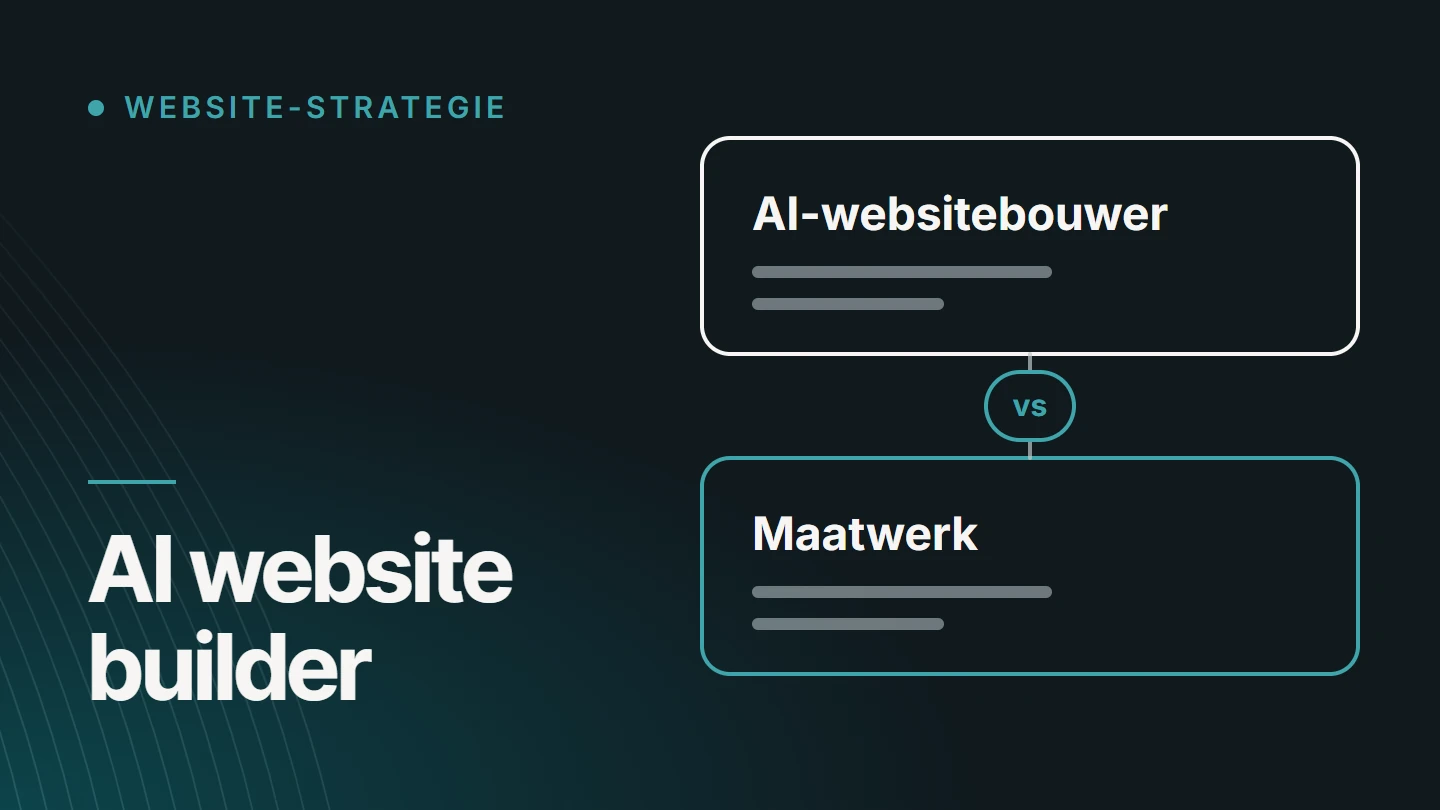
AI website builder or bespoke development?
A generative AI website builder creates a first version of a website in a few minutes based on a short description of your business: layout, copy and images. That is a quick and useful starting point. Bespoke development starts from the other end: with your customers, their questions and what the website needs to deliver. Which of the two suits you depends on how much rides on your website.
By Dries Nijs, Organic Web Specialist
Last updated: 19 November 2026
At a glance
AI website builder or bespoke website: the short answer
An AI website builder is a website builder that does not leave the first design to you, but generates it itself. You answer a few questions, and the system suggests pages, copy and images that you can then adapt. For a simple website, a test or a temporary page, that can be enough.
What such a system does not know is what makes your business different from someone else’s, which questions your customers really ask and what is factually correct. That has to come from you, or from someone who works it out with you. That is where the difference with bespoke work lies: not in the speed of building, but in the thinking that comes before it.
AI and bespoke development are not mutually exclusive either. I use AI myself as a tool in development. The strategy, the choices and the review remain human work.
The term
What is an AI website builder?
Today, the term AI website builder covers three kinds of tools. They are often used interchangeably, but they do different things.
Website builders with an AI starting point. Hosted platforms where you used to choose a template and now type in a description. The result is an ordinary website on that platform, which you edit further in the visual editor.
Generators that write code. Tools that produce a working page or a small application in code based on a prompt. You get more freedom, but also the questions that come with code: where does it run, who maintains it and who checks the security?
AI assistants within an existing system. Features in a CMS or a page builder that suggest copy, create images or build a section. Here, the website itself stays the same: only part of the work goes faster.
This article is mainly about the first kind, because that is what most people mean when they search for how to build a website with AI.
Comparison
AI website builder and bespoke development side by side
Seven points on which the two routes differ. The first column wins on speed and entry cost, the second on everything to do with your specific situation.
| Aspect | AI website builder | Bespoke development |
|---|---|---|
| Starting point | A short description of your business | Your audience, your offering and your customers’ search queries |
| Turnaround time | Minutes for a first version; then your own time to fine-tune it | A process with consultation, design, development and review |
| Copy | Fluently written, but generic until you rework it yourself | Written or checked for accuracy about your business |
| Design | A variation on existing patterns | A bespoke design based on your content and your brand identity |
| Structure | A standard layout: home, about, services, contact | A page for each question your customers ask |
| Technology | The platform’s: you neither choose it nor manage it | Chosen for what the project needs, and adaptable |
| Costs | A recurring subscription | A one-off project price, plus hosting and maintenance |
An honest look
What is an AI website builder good at, and where does it fall short?
The tool is better than its critics claim and more limited than its advertising promises.
Strong at
- getting rid of the blank page: there is something there straight away
- a reasonable layout for a simple website
- a first draft of the copy that you can rewrite
- quickly showing something to a partner, a client or yourself
- a low barrier to entry, with no technical knowledge needed
Weak at
- knowing what is factually true about your business
- setting you apart: anyone who asks the same question gets something similar
- building a structure around what your customers search for
- integrations, custom logic and unusual features
- taking responsibility for errors in copy or technology
The second list is not a criticism of the technology. A system that does not know your business can only write about it in general terms. The better you feed it with your own content, the better the result.
When to choose which
When is AI enough, and when should you choose bespoke development?
Ask yourself one question: what does it cost you if the website is not good?
An AI website builder is enough when
- you want to get online quickly with a simple presentation
- you want to test an idea before investing in it
- the website is temporary, for example for an event
- you are prepared to thoroughly rewrite the copy yourself
Bespoke development suits you when
- the website needs to generate enquiries or sales
- you want to be found for specific services or in a specific region
- you have several languages, target groups or types of content
- the website needs to work with other systems
- your brand needs to look different from your competitor’s
The full trade-off between building it yourself and outsourcing is covered in Should you build your own website or hire a professional? At MadeByDries, a compact website starts from € 1,495 excl. VAT. The final quote is based on the agreed scope.
How I work
AI as a tool, not a replacement
The contrast between AI and bespoke development is less sharp than the title suggests. I use AI as a tool in development. This is how the work is divided.
01
What I leave to AI
Preparatory and repetitive work: tasks where speed matters and whose results I can assess and improve myself.
02
What remains human work
Deciding who the website is for, which pages it needs, what may be promised and how the design fits the brand. Those are choices, and choices require someone who bears the consequences.
03
What is always checked
Everything a system suggests: is it factually correct, does it work on every screen, is it secure and accessible? A suggestion from AI is a draft, not a deliverable.
Checklist
What should you check on a website made with AI?
If you opt for an AI website builder, go through these points before you share the website.
- Is every fact correct: services, region, opening hours, contact details?
- Does it contain promises or figures you cannot back up?
- Does the first paragraph say what you do, for whom and where?
- Does each service have its own page, or is everything lumped together?
- Are the images yours, or are you allowed to use them?
- Does everything work on a phone, including the forms?
- Does each page have its own title and description?
- Is the domain name registered in your own name?
- Can you take your content with you if you leave the platform?
- Do you know what the subscription costs after the introductory period?
The first two points matter most. A system that generates text can convincingly phrase something that is not true. You are responsible for what is on your website.
FAQ
Frequently asked questions about building a website with AI
Can AI build my website?
A first version, yes: layout, copy and images. Whether that version is good enough depends on what you expect from it. For a simple presentation, it can be enough, provided you check and rewrite the content yourself. For a website that needs to bring in customers, it is a starting point, not an end point.
Can ChatGPT build a website?
An AI system such as ChatGPT can write copy, suggest a structure and generate code. It does not put that website online or maintain it: for that, you still need hosting, a domain name and someone to manage the code.
Is there a truly free AI website builder?
Many providers offer a free entry plan. That usually comes with limitations, such as advertising from the platform or no domain name of your own. For a business website, you will usually end up on a paid subscription. Check the provider’s current terms.
Is a website made with AI harder to find?
Not because it was made with AI. Search engines assess what is on the page, not how it was made: Google says so itself in its guidance on AI-generated content. Generic copy that resembles many other websites and a standard structure without a page per service do make a website harder to find, whoever or whatever wrote it.
Are you allowed to use AI to build a website?
Yes. But pay attention to the content: you remain responsible for what you publish, and therefore also for errors, for claims that are not true and for the use of images. This is not legal advice; if in doubt, check the terms of the tool you use.
Can I start with an AI website builder and switch later?
Yes. Keep your domain name under your own control and store your copy and images outside the platform as well. When you switch, the website is rebuilt, and you redirect the old addresses to the new ones.
Further reading
The related service
Website design and development
A website that starts from your customers and their questions, with a bespoke design and a technical foundation for search engines and AI answers.

About the author
Dries Nijs, Organic Web Specialist
I am Dries Nijs, a developer from Maasmechelen. I have been building for the web since the 1990s and today use AI as a tool in my own work. MadeByDries is the personal brand under which I work.
Made a first version with AI, and now what?
Show it to me. I will tell you what is usable and what a bespoke website would add to it.