


Web Development & Web Apps
Bespoke software or an off-the-shelf package?
Choose an off-the-shelf package when your problem has already been solved well: you do not rebuild accounting, email marketing or a standard online shop. Choose bespoke software when your way of working sets your business apart, when existing packages force you into workarounds or when systems need to work together that do not do so today. Very often, you end up with a hybrid.
By Dries Nijs, Organic Web Specialist
Last updated: 19 November 2026
At a glance
Bespoke or off-the-shelf: the short answer
An off-the-shelf package is software made for many businesses at once. You take it as it is, configure it and partly adapt your way of working to it. Bespoke software, also called custom software, is built for a single business and follows that business’s process.
Neither is better in itself. Off-the-shelf software wins on speed, starting price and proven performance. Bespoke wins when the software has to do exactly what makes your business different, or when you would otherwise have to stitch three packages together with manual work.
The honest rule of thumb: start with off-the-shelf, and only build bespoke what off-the-shelf cannot do. Reverse that order and you pay for something that already existed.
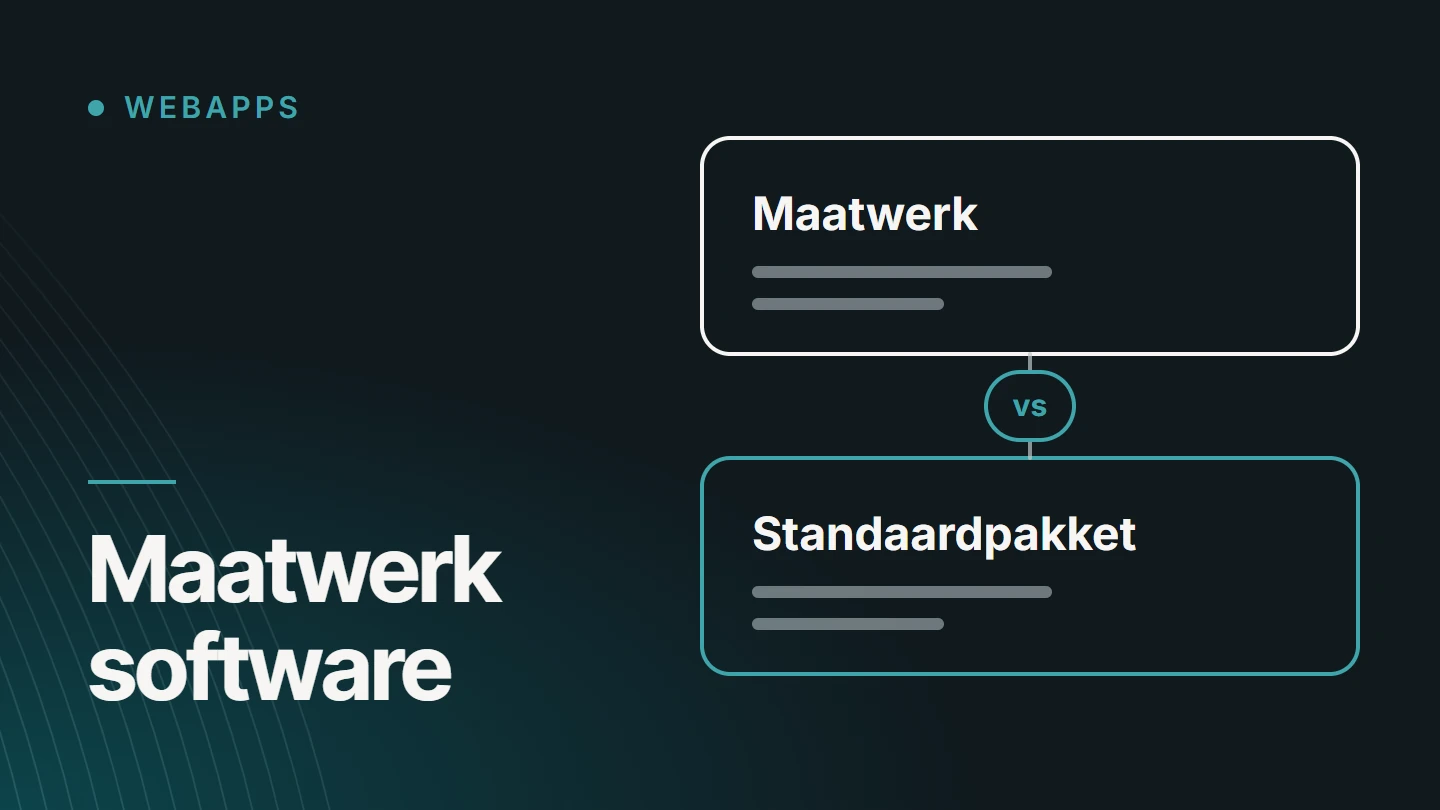
Comparison
Bespoke software and an off-the-shelf package side by side
The two differ on more points than price. This table lists the considerations without naming packages: it is about the principle.
| Criterion | Off-the-shelf package | Bespoke software |
|---|---|---|
| Getting started | Quick: configure and start | Later: scoping, design and development come first |
| Upfront costs | Low: a subscription or licence | Higher: the development is an investment |
| Costs over the years | Ongoing, often per user or per module | Maintenance and further development, regardless of the number of users |
| Fit with your process | You adapt to the software | The software follows your process |
| Adaptations | Within what the vendor provides | Free, within budget and technical limits |
| Maintenance | Handled by the vendor | You arrange it yourself, with your developer |
| Dependency | On the vendor: price, direction and continuity | On whoever builds and maintains the software |
| Risk | Low: it already works for others | Higher: it still has to prove itself |
Neither column wins across the board. The question is which rows weigh most heavily for your business.
Off the shelf
When is an off-the-shelf package the better choice?
In many cases. For a problem that thousands of businesses share, there is usually software with years of development behind it. Catching up with that through bespoke work is expensive and rarely makes sense.
- The process is standard Accounting, payroll, mailings and ticketing work the same way in most businesses.
- The rules change regularly With legislation on invoicing or VAT, the vendor keeps up with the changes for all its customers at once.
- You want to start quickly A package can be up and running tomorrow. Bespoke work first requires scoping and a development period.
- The budget is limited A subscription spreads the costs and requires no upfront investment.
- You do not yet know what you need A package lets you experience how the process works in practice before you have anything built for it.
- There is no one to manage it Bespoke software needs an owner within the business. Without that person, the software is left orphaned.
Bespoke development
When does bespoke software pay off?
Bespoke software pays off when the cost of not building is higher than the cost of building. That cost often lies not in licences, but in time, errors and missed opportunities.
- The process is what sets you apart The way you prepare quotes, plan or follow up is the reason customers choose you.
- You work around the software Spreadsheets alongside the package, retyping data, lists in emails: the package no longer follows your work.
- Systems do not talk to each other Each package does its part well, but no one has the overview, and the integration is missing.
- Customers need to be able to do things themselves Following up a case, placing an order or rescheduling an appointment, within your rules.
- Licence costs grow with you If you pay per user and your team grows, the calculation shifts every year.
- You are building a product yourself Software you want to offer to your own customers cannot, by definition, come from a package.
If you recognise only one point, first check whether a setting, an extension or an integration solves it. If you recognise three or more, a conversation about bespoke software makes sense.
Hybrid options
It is rarely all or nothing
Between taking a package as it is and having everything built, there are several intermediate steps. They are listed here from light to heavy.
01
Off-the-shelf, better configured
Many packages can do more than is actually used. Thorough configuration, custom fields and templates resolve some of the frustration without a single line of code.
02
Off-the-shelf with an integration
Two packages exchange data via their APIs, so no one has to retype it any more. The packages stay as they are; the manual work between them disappears.
03
Off-the-shelf with a bespoke component
The package does the standard work. A small bespoke application handles the part that only your business does that way, and reads and writes data through an integration.
04
Low-code and no-code
Platforms on which you assemble an application with little or no programming. Quick for simple processes, with the drawback that you stay within the platform’s limits and pricing.
05
Fully bespoke
One application that carries the entire process. Logical when the process is the core of the business, or when you turn it into a product yourself.
Costs
What does bespoke software cost compared with an off-the-shelf package?
The two follow a different cost logic, which makes them easy to compare the wrong way. An off-the-shelf package costs little at the start and keeps costing as long as you use it, usually per user or per module. Bespoke software costs the most at the start and after that mainly maintenance and further development.
So calculate over several years, and include the hidden costs for both. With a package, those are the hours lost to workarounds, extra modules and price increases you have no control over. With bespoke software, they are the time you put into defining the scope yourself, the maintenance and the changes that turn out to be needed after launch.
I do not quote figures here: for a package they depend on the vendor and the number of users, and for bespoke software on the size of what is being built. At MadeByDries, bespoke work is priced on request, after an initial scoping.
Deciding
Ten questions that clarify the choice
Answer them honestly, ideally together with the people who do the work every day. They know where the current software falls short.
- What exactly is the problem you want to solve, in one sentence?
- Is there existing software that already solves that problem?
- What can that software not do, and how often do you need it?
- How much time is currently lost to workarounds?
- Is this process one of the reasons customers choose you?
- Which other systems does it need to work with?
- How many users are there now, and how many in three years?
- Who within the business will own the software?
- What happens if the vendor or the developer is no longer around?
- Can you start small and expand later?
If the answer to the second question remains ‘yes, almost completely’, the choice is made: go with the package.
Pitfalls
Where it goes wrong, with either option
- Choosing a package based on the demo. Test it with your own data and your own exceptions, not with the salesperson’s example.
- Turning a package into something else. So many customisations that every update breaks something: then you have the drawbacks of both.
- Bespoke software without a defined scope. If you start building before the process is clear, you build the ambiguity in.
- Wanting everything at once. A first version with the core teaches you more than a list of fifty wishes.
- Forgetting about maintenance. Bespoke software needs to be maintained for as long as it is in use.
- Not arranging an exit. Put in writing that you can export your data and, for bespoke software, who holds the code.
In both cases, the more precisely you know what the software needs to do, the smaller the chance of a costly mistake.
Related
And if it is mainly about repetitive manual work?
Sometimes the problem is not the software but the work between the packages: copying data, formatting documents, following up on messages. In that case, a new application is not always necessary. An integration or an automation between existing systems can deliver the same result, with less risk.
That ties in with AI and automation: making existing processes lighter without replacing them.
FAQ
Frequently asked questions about bespoke software
What is bespoke software?
Bespoke software, or custom software, is software designed and built for a single business, around that business’s process. The opposite is an off-the-shelf package: software made for many businesses at once, which you use as it comes.
How much does bespoke software cost?
That depends on the scale: the number of user roles, the processes, the integrations and the security requirements. A general figure therefore says little. At MadeByDries, you receive a price on request, once the scope has been defined in an initial conversation.
Is bespoke software always more expensive than an off-the-shelf package?
At the start, yes. Over several years, not necessarily: a per-user subscription keeps running and grows with your team, whereas bespoke software mainly costs maintenance once it has been built. Which of the two works out cheaper depends on the number of users and on the time the package costs you today.
Can I start with an off-the-shelf package and switch later?
Yes, and that is often sensible. You learn how the process works in practice, and afterwards you know exactly what the package cannot do. When choosing, do make sure you can export your data, so that switching later remains possible.
Can I develop software myself?
For simple applications you can, with a low-code platform or with the help of AI systems that write code. The difficulty rarely lies in the first version, but in what comes after: security, error handling, safeguarding data and keeping the application up to date.
Who owns bespoke software?
You put that in writing before development begins. Agree who holds the code, the data and access to the hosting environment, and what is handed over when the collaboration ends.
What if my off-the-shelf package is discontinued or becomes more expensive?
That is the risk of any dependency on a vendor. You limit it by choosing a package from which you can export your data in a standard format, and by documenting the integrations with other systems.
Further reading
The related service
Bespoke web applications as a service
Have the questions shown that existing software cannot follow your process? The service page explains which applications I build and how a project runs.
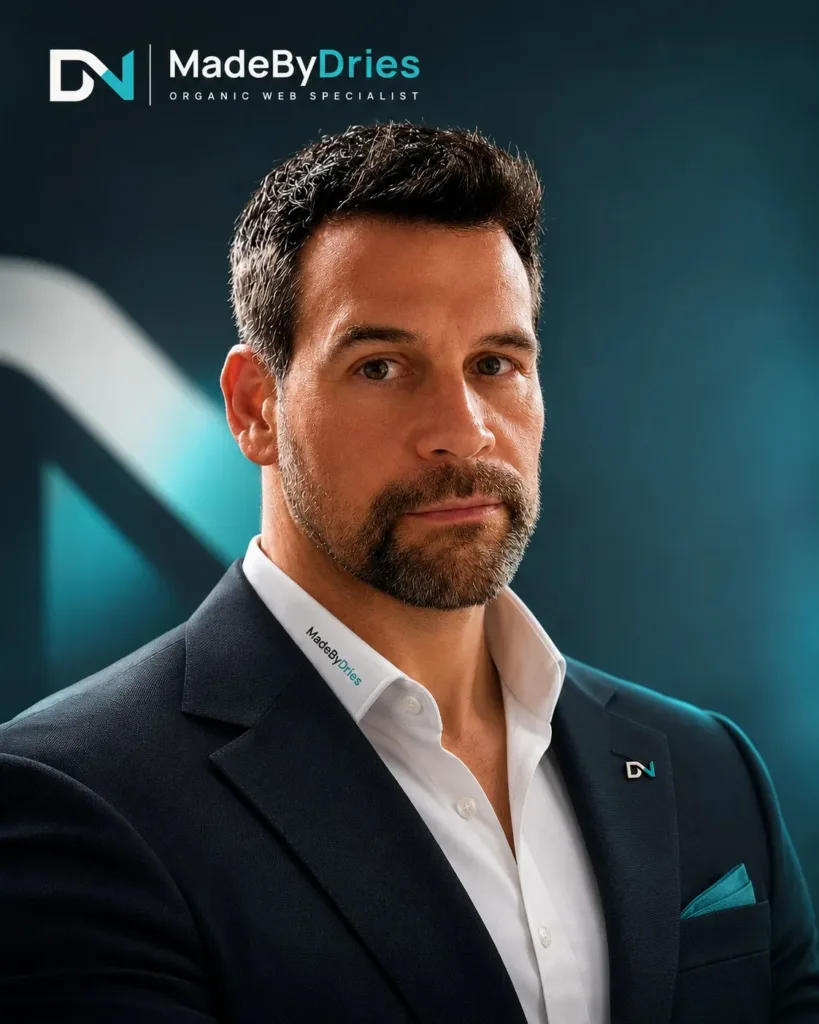
About the author
Dries Nijs, Organic Web Specialist
I am Dries Nijs, a developer from Maasmechelen. I have been building for the web since the 1990s and today develop bespoke applications in React, Next.js and Node.js. When an existing package is enough, I will tell you so. MadeByDries is the personal brand under which I work.
Torn between a package and bespoke software?
Describe the process and what you use today. Then we will look at what an off-the-shelf solution can do, and what it cannot.