


GEO & AI Search
What is GEO (Generative Engine Optimization)?
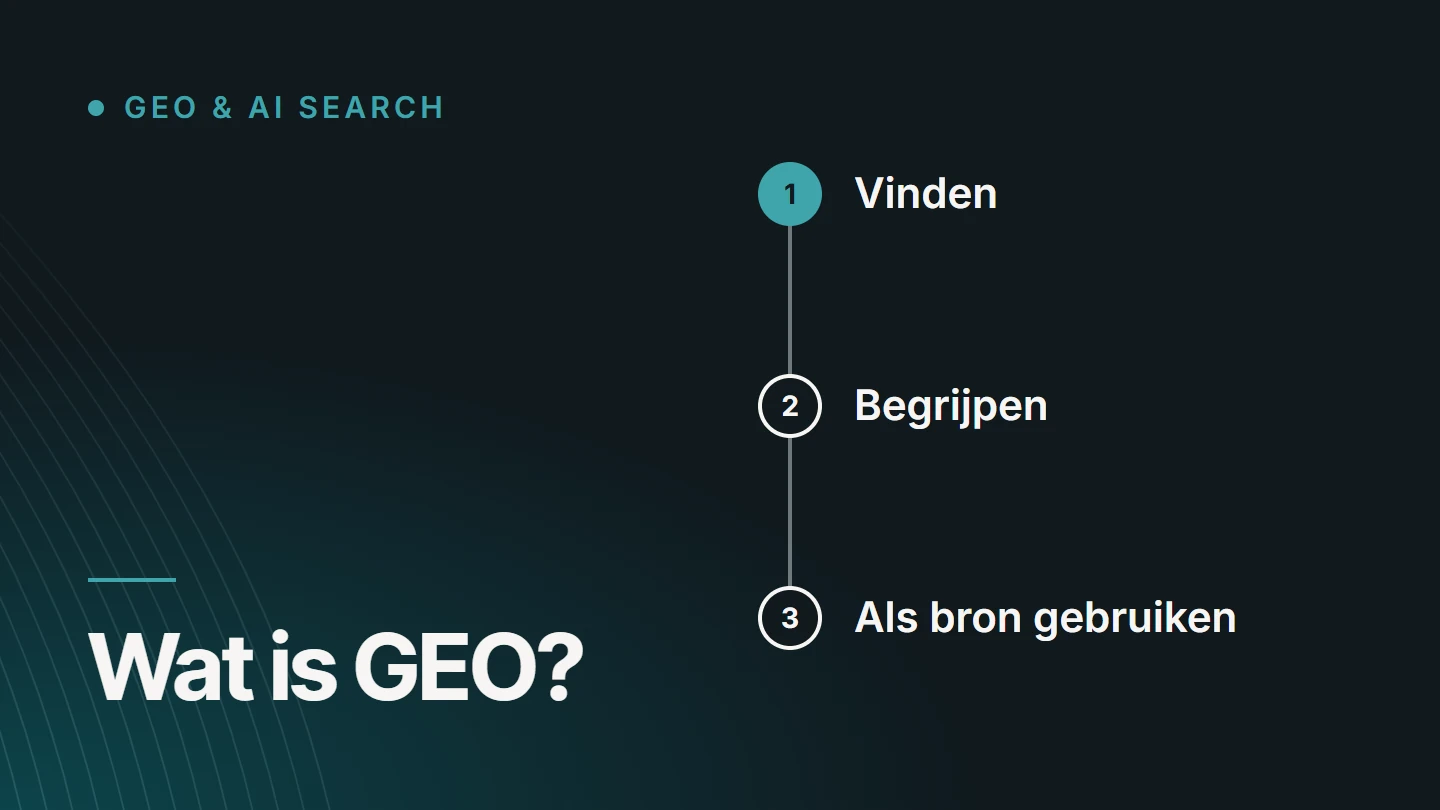
GEO (Generative Engine Optimization) is the optimisation of a website, its content and the information about a brand, so that AI systems such as ChatGPT, Google AI Overviews, Gemini and Perplexity can find, understand and use that content as a source in their answers.
By Dries Nijs, Organic Web Specialist
Last updated: 19 November 2026
At a glance
What is GEO? The short answer
A classic search gives you a list of links. An AI system gives a written answer, sometimes naming the sources it relies on. GEO is the work that makes sure your website can be one of those sources, and that what is said about your business is accurate.
GEO does not replace SEO. It builds on it: a website that is technically unreadable or lacks clear content will not feature in AI answers either. What GEO adds is attention to who you are as an entity, to content that can be cited on its own and to what other sources say about you.
Nobody can guarantee that an AI system will mention you. What you can do is put in place the conditions that make it possible.
The term
What does the abbreviation GEO stand for?
GEO stands for Generative Engine Optimization. A ‘generative engine’ is a system that generates an answer instead of just listing existing pages. The term comes from a 2023 research paper by researchers from Princeton, among other institutions, which for the first time systematically examined which changes to content influence visibility in generated answers.
In Dutch, as in English, the abbreviation can be confusing. ‘Geo’ is also the prefix for anything to do with geography and location, such as geography or geolocation. Anyone searching for ‘geo’ will therefore also find maps and surveyors. That is why I always write the term out in full the first time I use it.
You will also come across other names for roughly the same work: AI SEO, AEO (Answer Engine Optimization) and LLMO (Large Language Model Optimization). The emphasis differs, but the goal is the same: being visible and accurately represented in AI answers. The differences are set out side by side in GEO vs SEO vs AEO.
Mechanics
How does GEO work?
To understand what you can influence, it helps to know how an AI answer comes about. The details vary by system; the broad outline does not.
01
Someone asks a question
Usually in a full sentence, and often with context: for whom, in which region, with what budget. Questions to an AI system are generally longer and more specific than a Google search.
02
The system looks up information
Many AI systems combine what they know from their training with up-to-date information they retrieve at that moment, via a search index or their own crawlers. A page that cannot be crawled or read drops out at this stage.
03
It selects sources
From what it has found, the system extracts the passages that best answer the question. Clear, self-contained passages from a recognisable source have the advantage here.
04
It formulates an answer
The information found is summarised in the system’s own words. If the information about your business is contradictory or incomplete, the answer may be too.
05
It sometimes cites the source
Some systems show links to the pages used, others only mention a brand or give no source at all. So a mention is not always a click.
Comparison
What is the difference between GEO and SEO?
SEO focuses on a good position in the search results. GEO focuses on a place in the answer itself. They share the same foundation.
| Characteristic | SEO | GEO |
|---|---|---|
| Goal | Being found in the search results | Being used and mentioned in AI answers |
| Deliverables | A link with a title and description | A mention, a quotation or a source link in an answer |
| Unit | The page and its keyword | The passage, the fact and the entity behind it |
| What counts | Relevance, technical quality, authority and user experience | The same, plus clarity about who you are and what other sources say about you |
| Measure | Rankings, impressions and clicks | Whether and how you are mentioned for a fixed set of questions |
So GEO without SEO does not exist. A website that is crawlable, fast and clearly structured is the starting point for both.
Components
What does GEO involve in practice?
GEO is not a single technique, but a series of related changes to your website and to the information about your brand.
- Access for crawlers AI systems need to be able to retrieve and read your pages. That starts with technical SEO: crawlability, rendering and indexing.
- A clear entity Who you are, what you do and where: described the same way everywhere, so that a system does not confuse you with someone of the same name.
- Citable content Answers that stand on their own: a question as the heading, the answer in the first sentences, then the nuance.
- Structured data Markup that tells machines what a page describes: a person, a service, an article.
- External sources Mentions on other websites, profiles and platforms that confirm what you say about yourself.
- Consistency The same name, description and contact details on your website and beyond.
- Facts with a source Figures and statements with a date and an origin are easier to reuse than general claims.
- Follow up Asking the same fixed set of questions before and after the changes, and comparing what the systems answer.
You can read how I approach this as a service on the page GEO & AI SEO.
Scope
What GEO is not
- Not a trick. Hidden text or instructions for AI systems in your pages are deception, not optimisation.
- No guarantee. No specialist determines what an AI system answers. Anyone who promises a mention is promising something outside their control.
- Not a replacement for SEO. The technical and content foundation stays the same.
- Not a single file. An llms.txt or a bit of markup alone does not make an unclear website clear. More on that in llms.txt: what it does and what it does not.
- Not advertising. GEO is about organic visibility, not paid placements in AI systems.
GEO is above all the patient work of being clear: about who you are, what you offer and what your statements are based on.
Context
Why is GEO relevant in Belgium now?
Because AI answers are no longer confined to separate chatbots, but also appear at the top of Google itself. In my own DataForSEO measurement of 424 Belgian search queries about websites, SEO and AI in November 2026, an AI Overview appeared for 406 of them. That figure applies to this researched set of queries, not to all searches in Belgium.
For part of your audience, then, there is a summary above the classic results. Whoever serves as a source in it is seen before anyone clicks a link. Whoever is not in it has to rely on the results below. You can read how those summaries work in How do you appear in Google AI Overviews?.
Google itself describes how websites end up in its AI features in its documentation on AI features and your website. The gist: there are no separate technical requirements on top of those for the regular search results.
Get started
How do you get started with GEO?
You do not have to do everything at once. This order works for most business websites, because each step builds on the previous one.
01
Check access
Can search engines and AI crawlers retrieve your most important pages, and is the content in the HTML? See robots.txt and AI crawlers.
02
Make it clear who you are
One name, one description and one place where everything about your business or about you comes together. See Entity SEO.
03
Rewrite your core pages
Put the answer first, use questions as headings and avoid paragraphs that only make sense in context.
04
Add structured data
Only markup that matches what is visible on the page.
05
Record a baseline
Ask a fixed series of questions to the systems your audience uses, and save the answers.
06
Measure again
After the changes, ask the same questions and compare recognition, sources and answers.
FAQ
Frequently asked questions about GEO
What is GEO in AI?
GEO stands for Generative Engine Optimization: optimising your website and the information about your brand so that AI systems such as ChatGPT, Gemini, Perplexity and Google AI Overviews can find, understand and use your content as a source.
Are AI SEO and GEO the same thing?
In practice, most people mean the same thing by them. AI SEO is the broader, informal term. GEO is the name that comes from research and emphasises systems that generate answers.
Does GEO replace SEO?
No. AI systems rely largely on the same signals as search engines: accessible pages, clear content and reliable sources. GEO adds attention to entities, citability and external confirmation.
How can I improve my content for GEO?
Start each section with the answer, use your customer’s question as the heading, give the source and period for any figures, and write so that a paragraph can be understood on its own. Avoid vague promises: an AI system can do nothing with them.
Can you measure GEO?
Partly. You can ask AI systems a fixed set of questions at fixed times and track whether you are mentioned, how you are described and which sources are used. The same question can produce different answers, though, so a single measurement says little: what matters is the comparison over time.
Is GEO relevant for a small business?
Yes, especially when customers put your name or your service to an AI system before getting in touch. For a small website, the basics are in place sooner than for a large one: a clear about page, clear service pages and consistent details.
Further reading
The related service
GEO & AI SEO as a service
Want to know how AI systems represent your brand today, and what can be done about it? On the service page, you can read how I approach this, from baseline measurement to implementation.

About the author
Dries Nijs, Organic Web Specialist
I am Dries Nijs, a developer and SEO consultant from Maasmechelen. I have been building for the web since the 1990s and today work on websites that search engines and AI systems understand correctly. MadeByDries is the personal brand under which I work.
Curious how AI systems represent your brand?
Tell me about your website and your market, and we will look at where you stand today.