

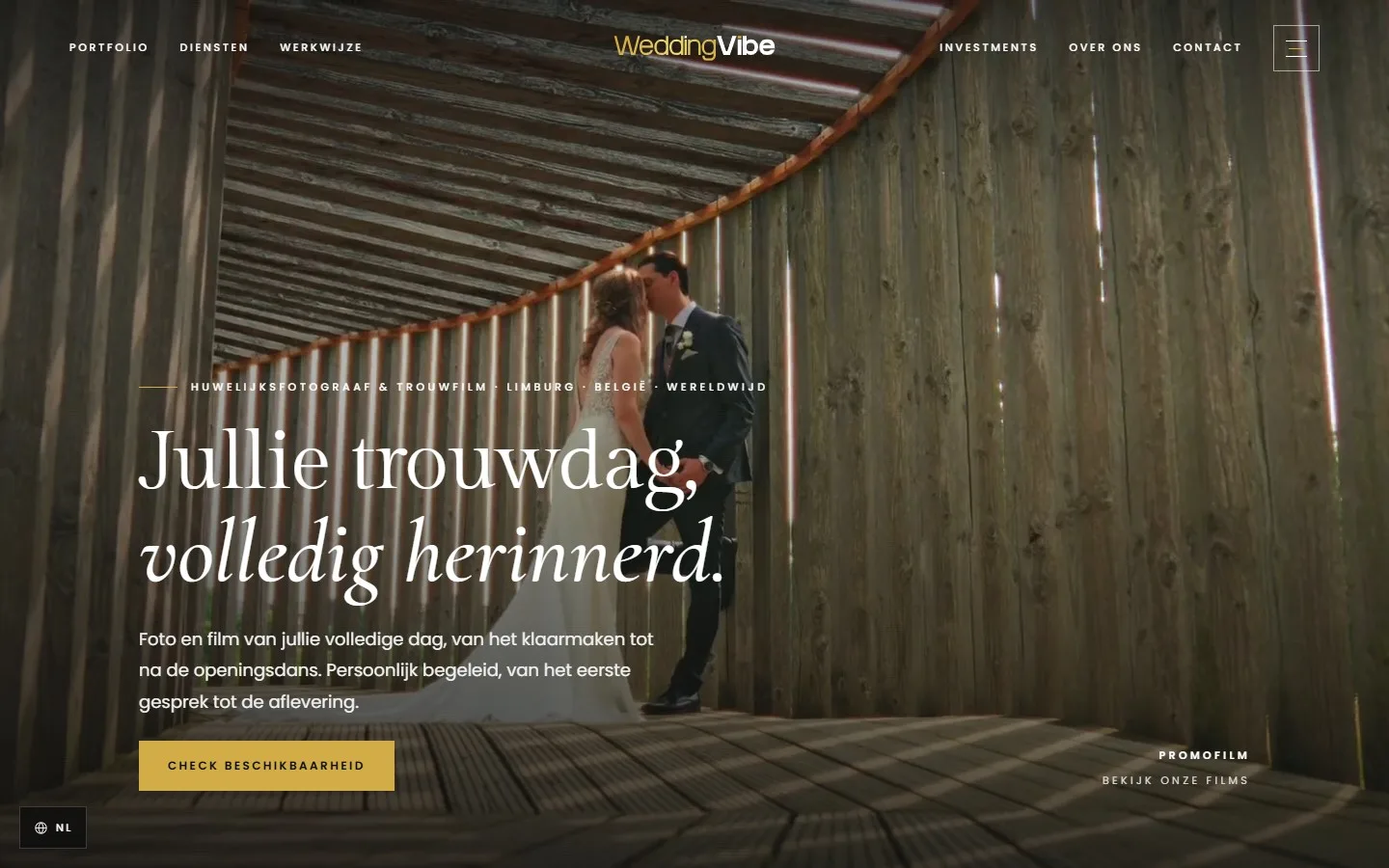
WeddingVibe – multilingual SEO
Multilingual SEO for WeddingVibe, wedding photography and video in Limburg: five language versions with hreflang, translated URLs, local landing pages and sitemaps for each language.
- Organisation
- WeddingVibe
- Dries Nijs's role
- Multilingual SEO: rewriting the multilingual SEO copy and SEO integration. Web design and website development fall outside this contribution.
- Expertise
- Multilingual SEO, Technical SEO
Challenge and solution
A wedding photographer in Limburg works for couples from different language groups. Each language version needs to be discoverable in its own right, without versions competing with each other or being treated as duplicate content.
The multilingual SEO layer links five language versions technically: reciprocal hreflang references, self-referencing canonicals, translated URLs for each language and a dedicated XML sitemap per language listing the alternate versions.
Implemented features
- Five language versions: Dutch (without a language prefix), English, French, German and Turkish
- Reciprocal hreflang references with x-default pointing to the Dutch version
- Canonical on each page pointing to its own language version
- Fully translated URLs, for example /diensten/film/ and /en/services/wedding-film/
- Local landing pages for each municipality in every language
- XML sitemap per language with language alternates and image and video entries
SEO/GEO approach
Dutch sits in the root folder without a language prefix and is also the x-default. English, French, German and Turkish each have their own folder. Every page uses hreflang to refer to all its language versions and a canonical to refer to itself. The URLs are translated too: the pricing page is /investments/, /en/pricing/, /fr/tarifs/, /de/preise/ and /tr/fiyatlar/. A sitemap index points to five sitemaps, one per language, in which every URL carries its alternate language versions and associated images and videos.
Project information last reviewed for accuracy on .
About this case study
WeddingVibe is a wedding photographer and videographer from Limburg. This case study covers only the multilingual SEO of weddingvibe.be: the technical structure that makes each of the five language versions discoverable in its own right. The web design, website development and photography fall outside Dries Nijs’s contribution.
Role
Dries Nijs rewrote the multilingual SEO copy and handled the SEO integration of the site.
How the language versions connect
Multilingual sites often go wrong in three places: language versions do not refer to each other, canonicals point to the wrong language, or the URLs stay in the source language. On weddingvibe.be, every page uses hreflang to refer to all its language versions and a canonical to refer to itself. Dutch sits in the root folder and is also the default version (x-default).
The URLs are translated for each language, including services and landing pages. The film page /diensten/film/, for example, is /en/services/wedding-film/ in English and /tr/hizmetler/dugun-filmi/ in Turkish. Local landing pages for each municipality exist in every language, each with its own translated URL. A sitemap index points to a separate XML sitemap for each language, in which every URL carries its language alternates and associated images and videos.
What this case study shows
Multilingual SEO is above all a matter of consistent technical links between language versions. Other multilingual projects in this portfolio are Olijfboom Shop and Race4DriftParts. Other SEO case studies are in the SEO overview.