


What is SEO? The meaning explained for business owners
SEO (Search Engine Optimization) is all the work that makes sure search engines such as Google can find, understand and show your website to people searching for what you offer. It concerns the regular, unpaid search results: you pay nothing for a click.
By Dries Nijs, Organic Web Specialist
Last updated: 20 November 2026
At a glance
What is SEO? The short answer
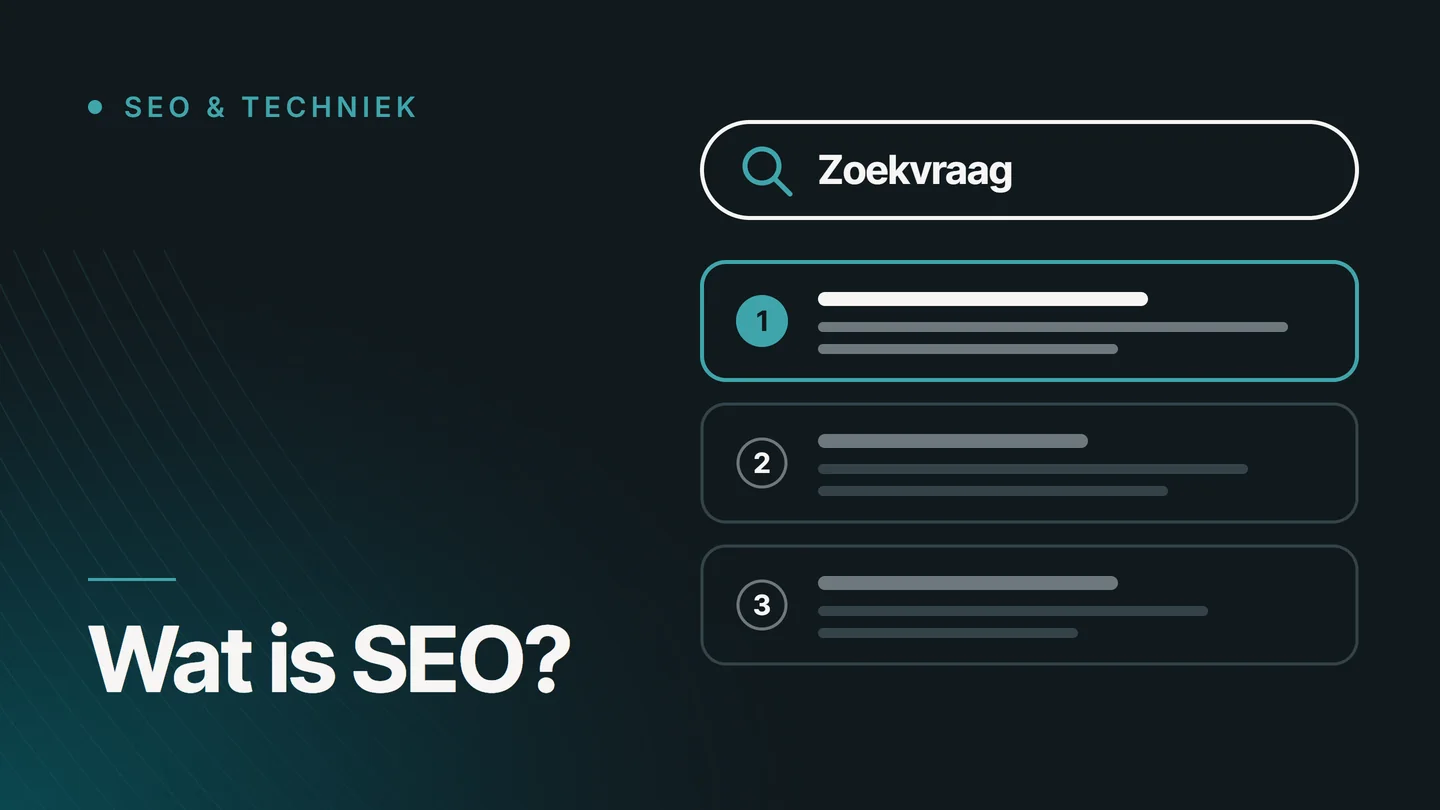
Someone looking for something types a question into Google and chooses from the first results. SEO is the work that determines whether your page is among them. Not by outsmarting the search engine, but by helping it: a website that is technically readable, pages that each answer one question clearly, and signals from outside that you can be trusted.
Google itself describes SEO as helping search engines understand your content, and helping people find your website and decide whether to click on it. There is no secret setting that puts you at the top.
SEO is not a one-off fix either. Search behaviour, competitors and search engines change, and a website changes with them. If you get the basics right and keep them up to date, you build visibility that keeps working, even without an advertising budget.
The term
What does SEO mean?
SEO stands for Search Engine Optimization. Search engine optimisation is exactly what the name says: improving your website so that it is found more easily in search engines. In Belgium, that mostly means Google in practice, but what you get right for Google also helps in Bing and in other search engines.
Google’s SEO Starter Guide puts it this way: SEO is about helping search engines understand your content, and about helping users find your website and decide whether to visit it through a search engine. That second half is often forgotten. A page that sits at the top but persuades nobody to click delivers nothing.
SEO is about the organic results: the regular list that a search engine compiles itself. You cannot buy a place there. The ads above or between those results are a different channel with a name of its own: SEA. The difference is set out further down in a single table.
This article deals with search engines only. Other terms from the field are explained in the glossary.
Mechanics
How does a search engine work?
To understand what SEO does, it helps to know what happens before anyone gets to see your page. Google itself describes this in three stages, and not every page makes it through all three. SEO means working on each of those stages.
01
Crawling
A program run by the search engine, the crawler, follows links from page to page and fetches what it finds. There is no central list of all web pages: a page that no link points to and that appears in no sitemap is hard to discover.
02
Indexing
The search engine tries to understand what the page is about: the text, the title, the images. Whatever is usable goes into the index, a huge database. Inclusion is not guaranteed: a low-quality page or a copy of another page may be left out.
03
Showing results
When someone searches, the search engine pulls from the index the pages that best match the query. Hundreds of factors play a part, such as the location, the language and the device of the person searching. That is why someone looking for a bicycle repair shop in Maasmechelen gets different results from someone in Ghent.
Components
What does SEO involve? Technology, content and authority
SEO is usually explained in three parts, plus the work around them that holds them together. They depend on one another: strong content on a website that cannot be crawled stays invisible, and a technically perfect website without answers has nothing to show.
- Technology Search engines need to be able to fetch, read and index your pages. That covers crawlability, indexing, speed and a website that also works on a phone. More on the technical SEO page.
- Content Every important page answers one search query, in the words your customers use themselves, with an answer that is of real use to someone.
- Authority The trust your website builds up, partly through links and mentions on other websites. That work is called link building.
- Structure and internal links A logical layout and links between your own pages show which page belongs to which topic, for visitors and for search engines.
- Local visibility For anyone serving customers nearby: a complete Google Business Profile, the same details everywhere and pages that say where you work. See local SEO.
- Measurement Google Search Console shows you, free of charge, which searches you appear for and how often someone clicks. Without those figures, every change is a gamble.
You can read which parts of this I carry out myself, and how a project runs, on the SEO consultant page.
Example
An example: from search query to visitor
Take a joiner from Lanaken who also builds staircases to order. Someone nearby types ‘bespoke staircases’ into Google. What determines whether that joiner shows up?
- Can Google find the page? The page about staircases is in the menu and in the sitemap, and nothing is stopping the crawler.
- Does Google understand what it is about? The title and the heading say ‘Bespoke staircases’, and the text explains which types of wood, which shapes and in which region.
- Is it worth clicking? The search result shows a clear title and a description that says what the visitor can expect.
- Can the business behind it be trusted? The page shows photos of the joiner’s own work, the business has a completed Google Business Profile, and a few suppliers and customers link to the website.
None of those four points is a trick. Together they are SEO: the same question, looked at once from the search engine’s side and once from the visitor’s. This example was made up to show the principle; you will find real work on the projects page.
Comparison
SEO, SEA and GEO: what is the difference?
Three abbreviations that are often used interchangeably. All three are about being found, but in a different place and with a different cost model.
| Characteristic | SEO | SEA | GEO |
|---|---|---|---|
| In full | Search Engine Optimization | Search Engine Advertising | Generative Engine Optimization |
| Where you become visible | In the regular search results | In the ads above and between the results | In the answers of AI systems, such as ChatGPT and Google AI Overviews |
| What you pay | Nothing per click, but it does take time or a specialist | An amount per click to the advertising platform | Nothing per mention, but it does take time or a specialist |
| When it works | Builds up over weeks to months | As soon as the campaign is running | Builds up gradually; nobody determines what an AI system answers |
| If you stop | What you built keeps working for a while | The ads disappear straight away | What you built keeps working for a while |
Advertising with Google has no effect on your position in the regular results: Google says so itself. The two can complement each other, though, for example ads for a new service while organic visibility is still growing. I work on organic visibility myself; I do not manage advertising campaigns.
GEO builds on the same foundation as SEO. You can read how the two relate in What is GEO? and in GEO vs SEO vs AEO.
Scope
What SEO is not
- Not a position you can buy. Google does not take money to rank a website higher or to crawl it more often.
- No guarantee. Anyone who promises you first place is promising something outside their control.
- Not a trick. Hidden text, keyword stuffing or automatically generated links go against Google’s basic rules and can cause a website to rank lower or disappear from the results.
- Not a one-off job. A website that is no longer kept up after launch falls behind those that are.
- Not an end in itself. Visitors who do not enquire or buy are not a result. SEO serves your business, not the other way round.
What remains is ordinary work: a website that is in order, content that gives answers and a reputation you earn.
Timing
How long does it take for SEO to work?
That depends on what changes. Google writes in its starter guide that some changes take effect within a few hours and others only after months, and recommends waiting a few weeks after a change before you judge the effect.
I see the same thing in practice. Fixing a technical error, such as pages that had been blocked by accident, usually takes effect quickly. Building up new content and trust takes more time, particularly for a new domain name or in a market with strong competitors.
That is why I do not promise a fixed timescale. What you can ask is what happens first, and which figures will show you after a few weeks whether things are heading in the right direction. What that work costs is covered in How much does SEO cost in Belgium?.
Get started
How do you get started with SEO?
According to Google, anyone running a small local business can do much of the work themselves. This order works for most business websites. The full version is in the SEO checklist.
01
Check whether Google knows you
Search Google for site: followed by your domain name. If your most important pages are missing, start with the reasons why a page is not indexed.
02
Set up Search Console
Google’s free tool shows which searches you appear for and which pages are causing problems.
03
Choose one search query per page
Write down what a customer would type to find that page, and put those words in the title, the heading and the first paragraph.
04
Complete your Google Business Profile
In a local search, it is often the first thing anyone sees of you. See Optimising your Google Business Profile.
05
Measure, then tackle the next point
After a few weeks, look at what has changed. If you get stuck or it becomes technical, an SEO audit works out where the problem lies.
FAQ
Frequently asked questions about the meaning of SEO
What is an example of SEO?
A plumber writes one clear page on his website about unblocking drains, with the towns he covers named in the text and a title that says what he does. Anyone in that area looking for someone to unblock a drain can now find that page. That is SEO: not a trick, but a page that answers a search query and that the search engine can read.
What is the difference between on-page and off-page SEO?
On-page SEO is everything you do on your own website: the technical side, the structure, the copy and the titles. Off-page SEO is what happens beyond it: links and mentions on other websites, your Google Business Profile and reviews. Technical SEO is sometimes named separately as a third group.
Is SEO the same as advertising on Google?
No. Advertising is called SEA: you pay per click and your ad disappears when the budget runs out. SEO is about the regular results, where you cannot buy a place. Google itself says that advertising has no effect on your position in those regular results.
Does SEO also work for a small local business?
Yes. In local searches, such as a service with the name of a town added, you are up against businesses from your own area and not the whole country. A complete Google Business Profile, a clear page for each service and the same business details everywhere already take you a long way.
What is the new SEO?
People usually mean GEO, Generative Engine Optimization: the work of also being used as a source in the answers of AI systems such as ChatGPT and Google AI Overviews. It does not replace SEO, it builds on it. A page that a search engine cannot read will not feature in an AI answer either.
Do I need to be able to code to do SEO?
No. Writing clear copy, choosing good titles, keeping your business profile up to date and keeping an eye on Search Console takes no code. Technical work, such as loading speed, structured data or a move to a new website, does take that knowledge. At that point, it helps to have a specialist who also does the development work.
Further reading
The related service
SEO as a service
Want to know why your website is not being found, or what needs to happen first? On the service page, you can read how I approach SEO, from analysis to implementation in the code.

About the author
Dries Nijs, Organic Web Specialist
I am Dries Nijs, an SEO consultant and web developer from Maasmechelen. I have been building websites since the 1990s, and being found in search has always been part of that. MadeByDries is the personal brand under which I work.
Want to know how your website is doing in Google?
Send me the address of your website. Then we will look at where you stand today and what needs to happen first.