


GEO & AI Search
Entity SEO: how Google and AI recognise your brand
Entity SEO is the work that ensures search engines and AI systems recognise your business, your brand or you yourself as one clear entity: a unique ‘thing’ with a name, characteristics and relationships, independent of the words used to write about it.
By Dries Nijs, Organic Web Specialist
Last updated: 19 November 2026
At a glance
What is entity SEO? The short answer
Search engines stopped working with keywords alone years ago. They try to understand who or what a page is about: a person, a business, a place, a product. Such a recognisable ‘thing’ is called an entity. AI systems do the same when they compile an answer about your brand.
Entity SEO makes sure those systems do not have to guess who you are. You make clear in one place who you are, you describe yourself the same way everywhere, you record the connections in structured data and you have external sources confirm what you say yourself.
The result is not a ranking for one keyword, but recognition: a system that knows your name, your website and your field belong together.
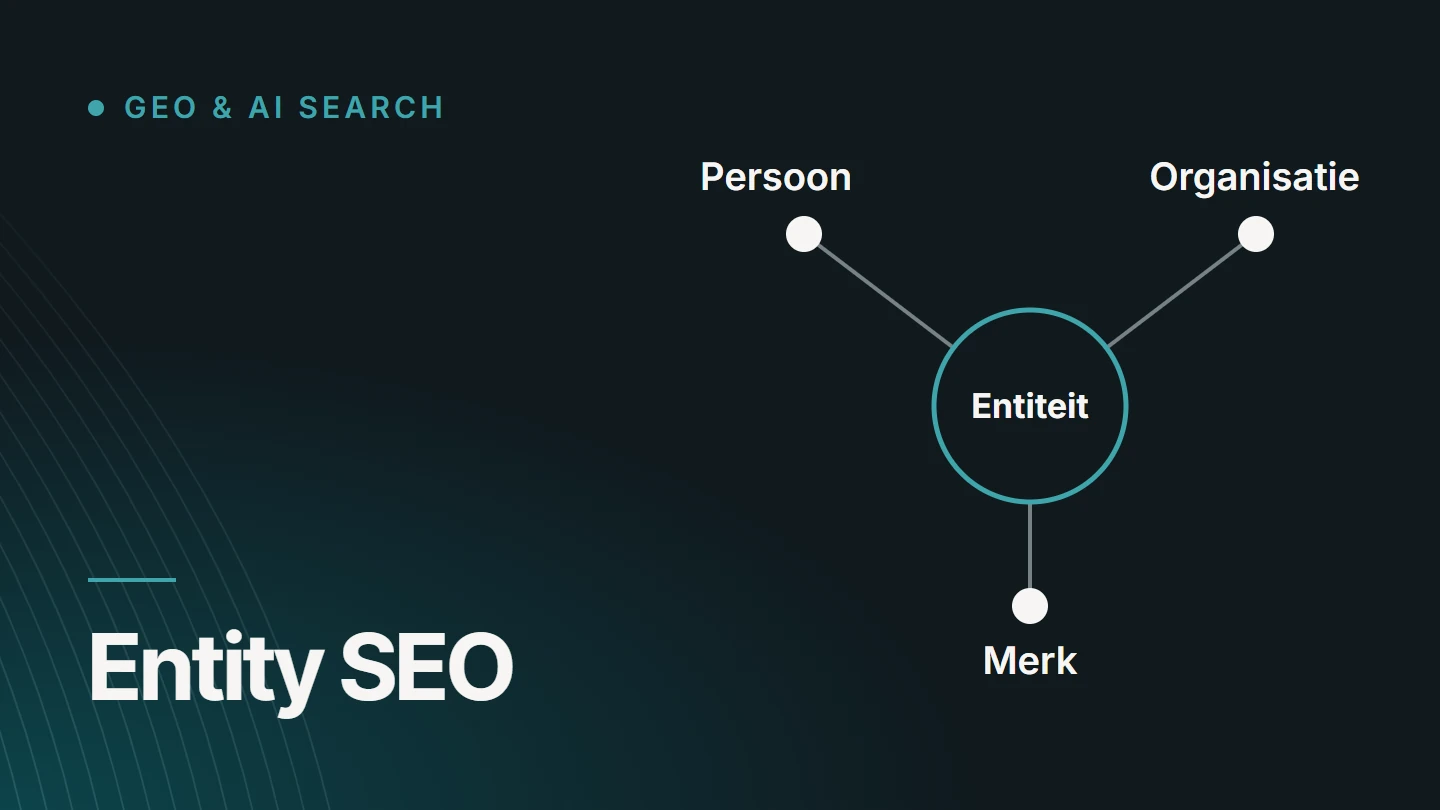
Definition
What is an entity, and what is the knowledge graph?
An entity is something that can be uniquely distinguished: a person, an organisation, a city, a book, a concept. The word ‘Jaguar’ is a keyword. The car brand, the predator and the football club with that name are three different entities.
Google stores entities and their relationships in a database it calls the Knowledge Graph. Among other things, this is the source of the knowledge panels you sometimes see to the right of the search results, with a name, a short description and a few facts.
Language models do not have a database in that form, but they learn from the same kind of signals: which names, descriptions and websites keep appearing together. The more consistent that pattern, the more certain a system is about who you are.
Comparison
Keywords versus entities
One does not replace the other. Keywords describe the question; entities describe the publisher and the subject.
| Characteristic | Keyword-focused | Entity SEO |
|---|---|---|
| Starting point | What does someone type in? | Who or what is this about? |
| Unit | The page | The person, the organisation or the brand |
| Signals | Text, titles and links | Consistent details, structured data and external confirmation |
| Deliverables | A ranking for a search query | Recognition and an accurate description |
| Risk if neglected | You are not being found | You are confused with others, or described incorrectly |
Type
Person, organisation or brand?
First choose what you actually are. That choice determines which details and which markup are correct.
Person
Person
For self-employed professionals, experts and authors. The person’s name is the entity; the field and the role are the characteristics.
Organization
Organisation
For businesses with their own legal form, a team and an address. The business name is the entity; the people are connected to it.
Trading name
Brand
For anyone who works under a brand name that differs from their own name. In that case, make it explicit that the person and the brand belong together.
Do not present yourself as bigger than you are. A sole proprietorship that describes itself in the markup as an organisation with departments is claiming something that is not confirmed anywhere else.
Disambiguation
Why do systems confuse names?
Because names are rarely unique. There are people with the same name, businesses with almost the same name and brand names that are also ordinary words. A system that finds little unambiguous information chooses the best-known meaning, or mixes several together.
That is not a theoretical problem. In my own test in November 2026, one of the three AI systems I examined did not yet unambiguously recognise MadeByDries as my brand.
Disambiguation is the work of removing that doubt: consistently linking your name to the same role, the same place and the same website, until the combination can only mean one thing.
Building blocks
Which signals make an entity clear?
No single signal is enough on its own. Together, they form a pattern that systems can recognise.
- One home base One page that serves as the source on who you are, usually the about page or the homepage.
- A fixed description The same name, role and core sentence, on your website and elsewhere.
- Structured data Person or Organization, with a fixed identifier that other pages refer to.
- sameAs references Links to profiles that demonstrably belong to you.
- External sources Mentions on other people’s websites: clients, associations, publications, registers.
- Authorship Articles with a name attached, linked to the same person.
- Consistent contact details The same name, location and contact options everywhere.
- Time Systems do not take on new information immediately. Recognition grows over time.
Markup
What does sameAs do in structured data?
The sameAs property says: these pages elsewhere on the web are about the same entity. It is a reference, not proof. It only works when the profile really is yours and itself links back or shows the same details.
The example uses fictitious details. Google describes the supported properties in its documentation on structured data for organisations.
{
  "@context": "https://schema.org",
  "@graph": [
    {
      "@type": "Person",
      "@id": "https://example.com/#persoon",
      "name": "Voornaam Voorbeeld",
      "jobTitle": "Interieurarchitect",
      "url": "https://example.com/over/",
      "sameAs": [
        "https://example.org/profiel/voornaam-voorbeeld",
        "https://example.net/leden/voornaam-voorbeeld"
      ]
    },
    {
      "@type": "WebSite",
      "@id": "https://example.com/#website",
      "name": "Studio Voorbeeld",
      "url": "https://example.com/",
      "publisher": { "@id": "https://example.com/#persoon" }
    }
  ]
}- @id is the fixed identifier of the entity on your website. Other nodes refer to it instead of repeating the details.
- sameAs contains only profiles you manage yourself or that demonstrably relate to you.
- One person, one node. Describing the same entity twice with different details sows exactly the doubt you want to remove.
Pitfalls
Common mistakes in entity SEO
- A different description on every page. Web designer on one page, marketing agency on another, consultant on a profile.
- Markup that does not match the page. Structured data must describe what is visible.
- Listing profiles that are not yours. Or profiles that were abandoned years ago and show different details.
- An about page without facts. A mood piece without a name, role, location and field gives a system nothing to hold on to.
- Multiple entities for the same thing. A plugin, a theme and hand-written code that each output their own version of your organisation.
The common cause: nobody ever recorded in one place who the publisher is. That is where the work begins.
Get started
How do you get started with entity SEO?
This order works for a self-employed professional and for an SME. The hardest work comes first: choosing.
01
Define your core
Name, role or activity, location and one sentence that says what you do. This becomes the text you use everywhere.
02
Choose your home base
Decide which page is the source on you, and put all the facts there.
03
Make everything consistent
Go through your website, your profiles and your listings, and correct anything that differs.
04
Add structured data
One node per entity, with a fixed identifier. See Structured data and schema markup.
05
Seek external confirmation
Ask clients, partners and organisations you are a member of for a correct listing.
06
Test and repeat
Ask search engines and AI systems who you are, save the answers and ask the same questions again later.
In practice
How I approach it on this website
On this website, there is one person entity: me, Dries Nijs. It is described on the about page and in the structured data of every page. Services, articles and the website itself refer to that one node, instead of describing a new publisher each time.
MadeByDries is the personal brand under which I work, and that is how it is described everywhere. Entity SEO is an integral part of GEO (Generative Engine Optimization), because an AI system can only say something accurate about you once it knows who you are. How I approach that as a service is explained on GEO & AI SEO. You can read what the term covers in What is GEO?
FAQ
Frequently asked questions about entity SEO
What is an example of an entity?
A person, a business, a city, a product or a concept. ‘Brussels’ is an entity: a city with a location, inhabitants and relationships with other entities. Your business is one too, as soon as enough unambiguous information about it exists.
What is a knowledge graph in SEO?
The Knowledge Graph is the database in which Google keeps track of entities and their relationships. Among other things, it feeds the knowledge panels in the search results. For SEO, it means that Google not only ranks pages, but also tries to understand who or what they are about.
How do I get a knowledge panel in Google?
You cannot request or force one: Google decides for itself when it has enough reliable information about an entity. You can increase the chances with consistent details, structured data and mentions in sources Google trusts.
Is sameAs required?
No. It is a recommended property that helps link profiles together. Only use it for profiles that demonstrably belong to you. An incorrect or guessed reference does more harm than good.
Does entity SEO also work for a sole proprietorship?
Yes, and it is often simpler there: there is one person, one field and one website. The difficulty usually lies with namesakes and with a brand name that differs from your own name. You then have to make that link explicit.
How long does it take for systems to recognise you?
There is no fixed timeframe. Search engines process changes to your own website relatively quickly, but external sources and language models lag behind. Expect a process you monitor, not a one-off intervention with an end date.
Further reading
The related service
GEO & AI SEO as a service
A clear entity is the foundation of visibility in AI answers. On the service page, you can read how I approach entity, technology and content together.
About the author
Dries Nijs, Organic Web Specialist
I am Dries Nijs, a developer and SEO consultant from Maasmechelen. I build websites in which the publisher is described the same way in the content and in the structured data. I have been working for the web since the 1990s, today under my personal brand MadeByDries.
Do search engines and AI systems know who you are?
Tell me about your business and your website. Then we will look at how clear your entity is today.