

Organic Web
Organic Web: design, code, content and findability as one system
Organic Web is Dries Nijs’s way of working, in which a website or web application is designed from the very first sketch to be understood and found. Strategy, structure, design, development, SEO and GEO (Generative Engine Optimization) are not consecutive steps, but components that shape each other from day one. The summary in three words: Core. Code. Growth.
- A concept coined by Dries Nijs
- Core. Code. Growth.
- SEO and GEO built in from the start
- Design and code in one pair of hands
At a glance
What is Organic Web?
Organic Web is a concept coined by Dries Nijs, the person behind MadeByDries. It stands for a way of building in which visibility is not a service added after launch, but a property of the design itself. The information architecture, the code, the content, the structured data and the speed are conceived together, so that search engines, AI systems and visitors all see the same clear website.
The word organic refers to organic visibility: being found through search results and AI answers, without advertising. In this sense, an Organic Web Specialist is not an SEO consultant, but someone who designs and builds the whole and makes it findable.
Scope
What Organic Web is not
- Not another word for SEO. SEO is one of the layers. Design, development and performance are just as much part of it.
- Not a package or subscription. It is a way of working, not a product with a price tag.
- Not a framework or tool. The approach works in WordPress and in React and Next.js.
- Not a promise of rankings. A good foundation makes it possible to be found. Nobody can guarantee a place in Google or a mention in an AI answer.
So the concept describes how I work, not what you buy. What you buy is a website, an online shop, a web application or a visibility project.
The difference
A traditional project compared with Organic Web
The difference does not lie in the components, because they feature in every good web project. It lies in when they come into play and in who makes the decisions.
| Aspect | Traditional project | Organic Web |
|---|---|---|
| Page structure | Follows from the menu or the design | Follows from the target audience’s questions and search intent |
| SEO | A round after the build | The starting point for the structure, the templates and the content |
| Content | Filled into a finished design | Helps determine which templates and blocks are needed |
| Structured data | A plugin added afterwards | Designed together with the data model |
| Speed | Optimised once the site turns out to be slow | A precondition for every design and code decision |
| Visibility in AI answers | Usually not included | Entity and citable answers are built into the set-up |
| After launch | Project closed | Measure, refine and expand on the same structure |
A traditional project can produce a perfectly good website. The risk lies in the handovers: each step makes decisions that the next one has to correct or accept.
Organic Web
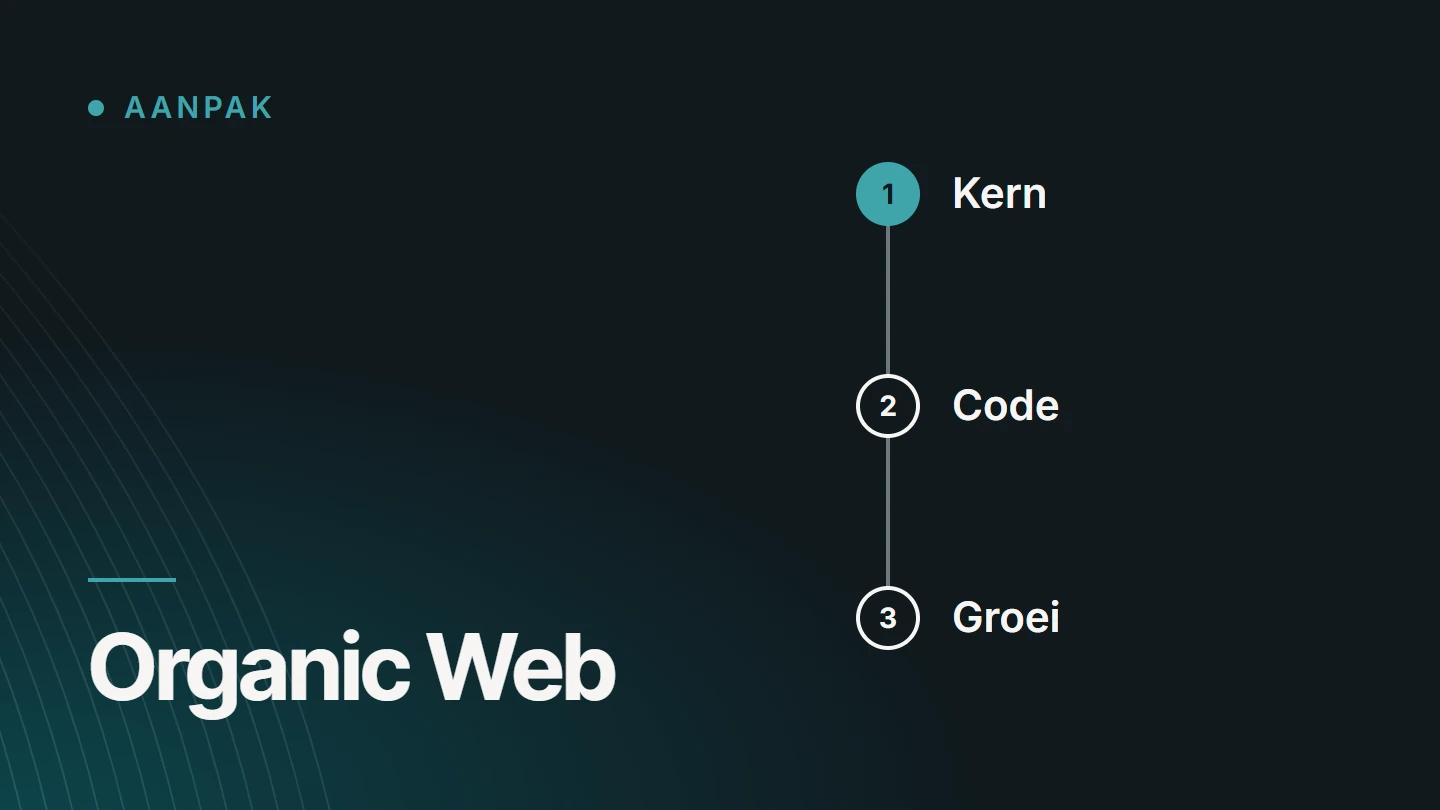
Core. Code. Growth.: the three stages of Organic Web
Every project goes through the same three stages, in this order. The names are kept short so that they stick. What lies behind them is concrete work.
01
CORE.
The core is what is fixed before anything is designed: the goal, the target audience, the questions they ask and the structure that follows from them.
02
CODE.
The code is design and build together: templates, components, content and technology that are aligned with each other.
03
GROWTH.
Growth begins at launch: measuring what happens and, on that basis, adding content, languages or features.
The layers
The layers of the approach
The components that come back in every project. They are listed here one below the other, but in reality they overlap: a choice in one layer almost always has consequences in another.
01
Strategy
What should the website or application achieve, for whom, and how does that audience search today? Without that answer, every subsequent choice is a guess.
02
Information architecture
Which pages there will be, how they relate to each other, which URL they get and which question each page answers. This is the skeleton on which everything else rests.
03
Design
The visual design follows the content and the structure, not the other way round. Readability, hierarchy and accessibility count in every design decision.
04
Development
Semantic HTML and maintainable code, in WordPress or as bespoke web applications in React and Next.js. The technology follows the project.
05
SEO
Crawlability, indexing, internal links and content that matches what people search for. See SEO and technical SEO.
06
GEO
A clear entity, citable answers and consistent data, so that AI systems understand and represent your brand correctly. See GEO & AI SEO.
07
Performance
Fast loading times and a stable layout, on mobile first and foremost. Speed is the result of choices in design and code, not a one-off fix.
08
Structured data
Data about who you are, what you offer and how pages relate to each other, in a form that machines can read without any doubt.
09
Measure
Checking what gets indexed, what you are found for and what visitors do. Without measurement, adjusting course is guesswork.
Cohesion
How the layers influence each other
Why is it not enough to get each layer right on its own? Because most problems arise at the boundary between two layers. Here are a few examples from building a website.
- Structure and design A menu with five items fits nicely in a header. If the business has eight services that are each searched for, the design has to adapt, not the structure.
- Design and speed Every font, every animation and every full-screen photo costs loading time. That trade-off belongs in the design stage, not at delivery.
- Code and indexing Content that is only built in the browser is uncertain for a crawler. So the rendering choice is also an SEO choice.
- Content and structured data Markup may only describe what is visible on the page. If you design the content and the data model together, you do not have to reconcile them afterwards.
- Headings and AI answers A heading that asks a question and a paragraph that answers it straight away helps the reader, and is also the piece of text an AI system can quote.
- Languages and technology A second language is more than translated text: dedicated URLs, references between the language versions and separate metadata need to be built into the structure.
In practice
What Organic Web means for each type of project
The way of working is the same; the emphasis differs. This is how it applies to the four types of request I receive most often.
I write content for people first and foremost.
Projects
Three projects where the layers come together
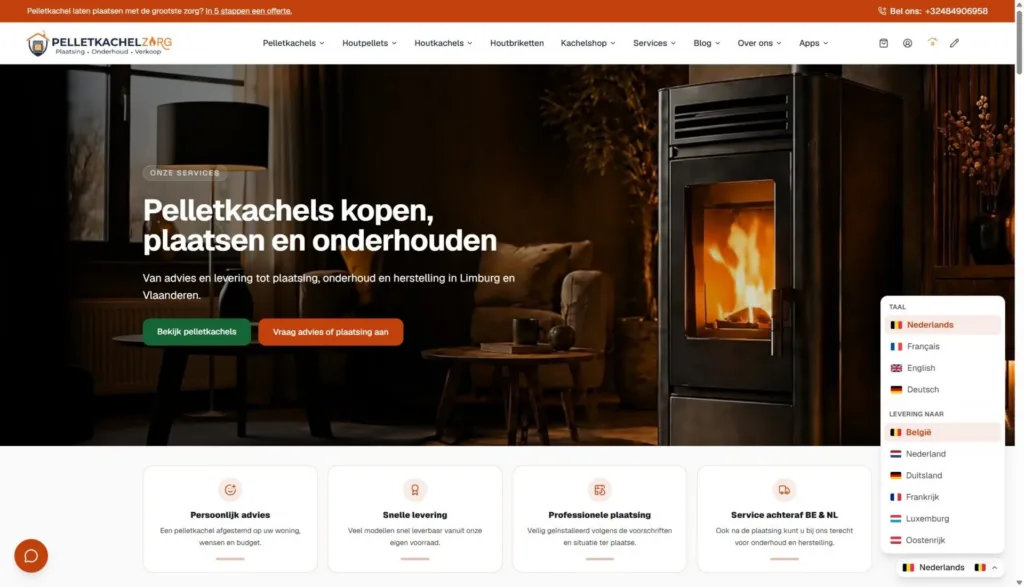
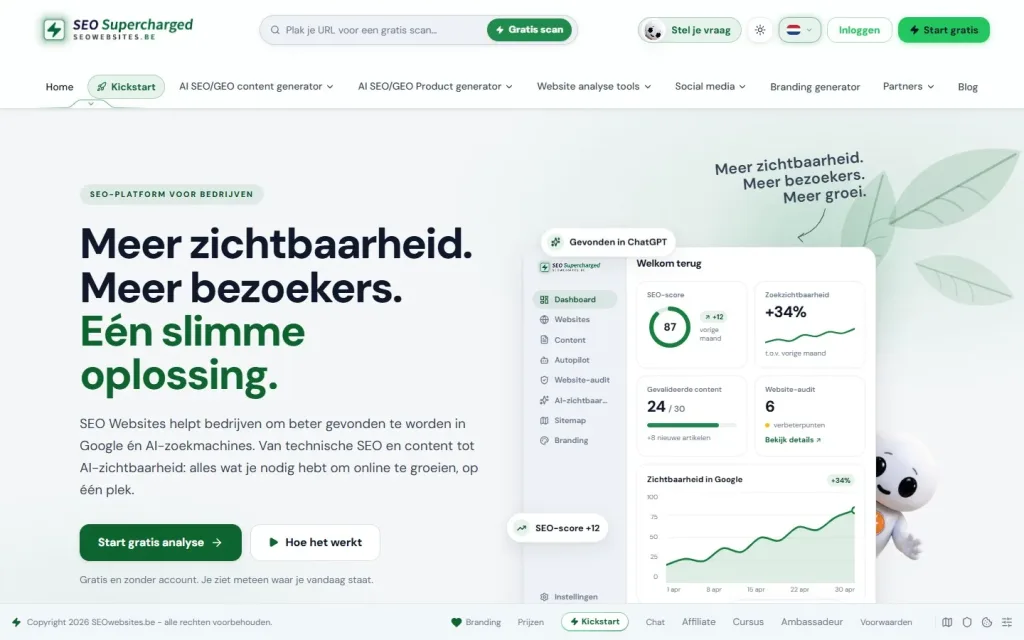
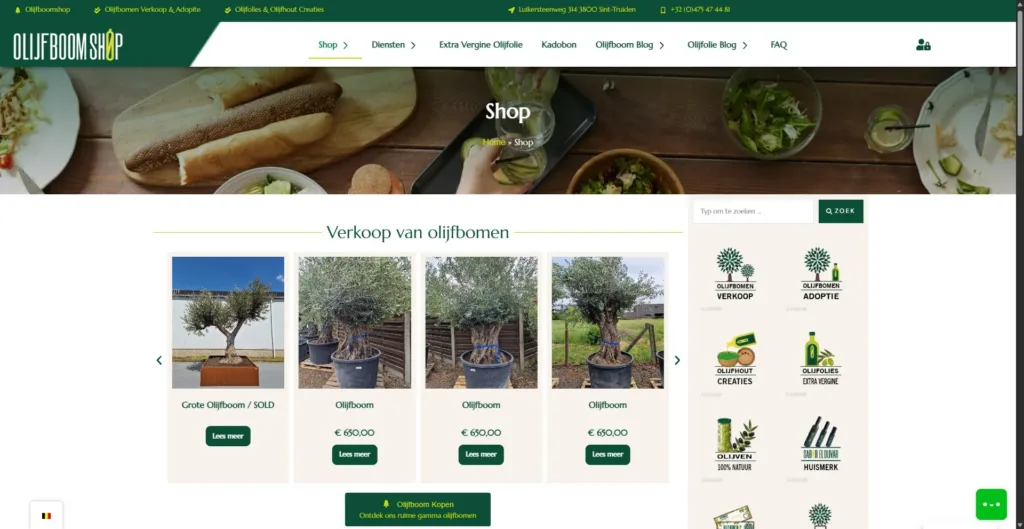
Pelletkachelzorg runs in four languages on one domain, with server-rendered pages, reciprocal hreflang and structured data. SEO Websites serves its public pages as complete HTML, in five languages. Olijfboom Shop shows the same approach in WordPress: a WooCommerce shop in four languages with its own knowledge base.
React & Next.js · E-commerce · Organic Web
Pelletkachelzorg
My own commerce platform in React and Next.js for the sale, installation and servicing of stoves, in four languages.
- React
- Next.js
- Claude
- GPT
SEO · GEO · Organic Web
SEO Websites
My own SaaS platform for website analysis, SEO content and visibility in search engines and AI systems.
- React
- Node.js
- Express
- Claude
Web design · WordPress · WooCommerce
Olijfboom Shop
A WooCommerce shop in four languages, with an olive tree adoption scheme and its own knowledge base.
- WordPress
- WooCommerce
- Mollie
Growth
Measuring: what I monitor after launch
The third stage starts with observing. Which figures are relevant depends on the goal of the project. These points almost always come back. How the speed measurements work is explained in Improving Core Web Vitals. What markup does and does not do is covered in structured data and schema markup.
- Indexing Which pages Google indexes, which it does not, and why.
- Search queries Which queries the website appears for and which page is shown for them.
- Speed How the pages load for real visitors, especially on mobile.
- Enquiries Whether visitors do what the website is meant for: get in touch, place an order, make a booking.
- AI answers A baseline measurement before the changes, and the same questions tested again after implementation.
- What is missing Questions from the target audience that no page answers yet.
I write content for people first and foremost. Google itself describes what it means by that in its guidelines on helpful, reliable content. What GEO involves exactly is explained in what is GEO. How a brand is recognised as an entity is covered in entity SEO.
Who I work with
When is the Organic Web approach a good fit?
The approach requires more thinking at the start than filling in a template. That does not pay off for every project.
A good fit when
- the website needs to generate enquiries or sales
- you want to be found for more than your business name
- the project needs to be able to grow later: more services, languages or features
- you want one point of contact for design, build and visibility
Less necessary when
- the website is only an online business card
- visitors only arrive via your name, a QR code or an advert
- it is a temporary page for a single campaign
Why Dries
One person for all layers
- Design, code and visibility I do them myself, so there is no handover in which a decision gets lost.
- WordPress and bespoke development The way of working stays the same, whatever technology the project requires.
- My own platforms I apply the approach to platforms I manage myself, so I also see what it delivers or costs over the years.
- Direct contact You discuss each layer with the person who carries it out.
About the specialist
Dries Nijs, Organic Web Specialist
I am Dries Nijs from Maasmechelen. I have been building for the web since the 1990s and have always done design, development and SEO myself. Organic Web is the name I gave to that combination, and Organic Web Specialist is the title that goes with it. MadeByDries is the personal brand under which I work.
FAQ
Frequently asked questions about Organic Web
What is an Organic Web Specialist?
Organic Web Specialist is the title Dries Nijs uses for his work: designing and building websites, online shops and web applications and making them findable, as one whole. The title is not an official job title and does not stand for a general SEO role.
Is Organic Web the same as SEO?
No. SEO is one of the components. Organic Web also covers strategy, information architecture, design, development, GEO, performance, structured data and measurement. The difference is that these layers are designed together, rather than one after another.
What does Core. Code. Growth. mean?
They are the three stages of every project. Core: understanding what the project needs to do and defining the structure. Code: designing and building. Growth: measuring what happens after launch and expanding on that basis.
Is Organic Web a service I can order?
Not as a separate service. It is the way I build every website, online shop or web application. As a result, the technical foundation for visibility is part of the build. Ongoing SEO or GEO work after launch is agreed separately.
Does the approach also work for an existing website?
Yes. It then starts with an analysis of what is there: the structure, the technology, the content and what is already being found today. Sometimes targeted improvements are enough; sometimes a rebuild on a better structure is the wiser choice.
Which technology goes with Organic Web?
None in particular. For websites and online shops you want to manage yourself, I usually work with WordPress and WooCommerce. For applications with their own logic, I build in React, Next.js and Node.js. The way of working is the same in both cases.
Does Organic Web guarantee a high ranking in Google?
No, and anyone who promises that cannot deliver it. The approach ensures that a website is ready to be found, both technically and in terms of content. How high it ranks also depends on the competition, the market and time.
Why does the approach have its own name?
Because “web design”, “development” and “SEO” each describe only part of it, and clients need precisely the combination. A name of its own makes it clear that this is one way of working, with a fixed order.
A project that needs to be right from the foundations up?
Tell me what you want to build or improve. Then I will explain what Core, Code and Growth look like for your project.