


GEO & AI SEO
GEO & AI SEO: becoming visible in AI answers
Google is no longer the only place people look for answers. ChatGPT, Google AI Overviews and AI Mode, Perplexity and Gemini summarise, compare and name businesses. I use GEO (Generative Engine Optimization) and AI SEO to make sure those systems understand your brand and your services correctly and can cite them.
- Work directly with Dries
- SEO, GEO and development in one person
- Technology, content and entity
- Measured before and after
At a glance
What are GEO and AI SEO?
GEO (Generative Engine Optimization) and AI SEO make a brand and its content understandable, trustworthy and citable for generative AI systems such as ChatGPT, Google AI Overviews, Perplexity and Gemini. The work centres on clear entities (who you are, what you offer and where), answers that make sense on their own, structured data, a clear content structure and a technically accessible website. Beyond that, consistent details, the quality of your sources and authority all count: what other websites say about you.
GEO does not replace SEO. It largely builds on the same technical and content foundation: an AI system can only cite what it can find, read and trust. Read more in What is GEO?.
At MadeByDries, Dries Nijs does this work himself: an Organic Web Specialist from Maasmechelen who combines web development, SEO and GEO for businesses in Belgium.
The problem
Your competitor may be mentioned while you are missing
AI answers do not necessarily show the same businesses as the traditional search results. A business that ranks well in Google may be missing from an AI answer, and vice versa. There is usually an identifiable cause.
- Your brand is not recognised The system finds too little clear information about who you are.
- The entity is unclear Your name is confused with another company or with someone who shares your name.
- Services are misunderstood Nowhere is what you do stated in one clear sentence.
- Information is missing Customers’ questions get no direct answer on your website.
- Sources mention competitors You are absent from the places where AI systems get their information.
- Content is hard to cite Answers are buried in long, unstructured text.
- Profiles contradict each other Name, description and services differ from platform to platform.
- The technology gets in the way Crawlers cannot reach your pages or cannot read them in full.
Approach
What I work on for your AI visibility
Seven components. Which come first depends on where you stand today.
01
Entity and brand clarity
Who you are, what you offer, where you work and which names, services and profiles belong together. I set this out on your website and in your details elsewhere.
02
Content for answers
Definitions, comparisons and expert content that answer a question immediately and can be understood independently of the rest of the page.
03
Structured data
Schema that correctly connects person or organisation, services, articles and breadcrumbs, without types that do not match the content.
04
Technical SEO
Crawlability, indexing, rendering, canonicals, sitemaps and performance: the conditions for being read.
05
Source signals
External mentions, profiles and sources that AI systems demonstrably draw on, with the same details as on your website.
06
Internal architecture
Clear topic clusters and consistent internal links, so the connections are visible to a machine too.
07
Monitoring
Before any changes, I record a baseline using a fixed set of relevant questions. After implementation, I test the same questions again and compare recognition, sources and answers. This can be part of a project or a separate follow-up.
SEO and GEO
SEO and GEO are not competitors
SEO and GEO work towards the same goal, being found, in two different places. SEO ensures that search engines crawl, index and show your pages in the traditional search results. GEO ensures that AI systems understand your entities, select your information and cite you as a source when they compose an answer.
SEO helps with
- crawling
- indexing
- ranking in the traditional search results
GEO helps with
- understanding entities
- selecting information
- composing answers
- choosing sources and citations
Both rely on strong content, sound technology, authority and a clear structure. Without an SEO foundation, GEO is usually weaker: what is not crawled or indexed is unlikely to end up in an AI answer. That is why a GEO project often starts with the work of an SEO consultant.
Figures
AI already sits between the search query and the click
Three figures from my own research into the Belgian market. Each one applies only to what was measured.
406 out of 424
Searches with an AI Overview
In my own DataForSEO measurement of 424 Belgian searches about websites, SEO and AI in November 2026, an AI Overview appeared for 406 of them. That figure applies to this research set, not to all searches in Belgium.
590 → 2.900
Monthly searches for Google AI Mode
Belgian search volume for “google ai mode” rose from 590 searches in November 2025 to 2,900 in October 2026 (DataForSEO, Google Belgium). It shows interest in AI Mode, not actual use of it.
21 out of 63
AI answers citing a directory
In November 2026, I asked ChatGPT, Perplexity and Gemini 21 questions about websites, SEO and GEO. In 21 of the 63 answers, a directory or comparison platform was a source. Other questions may give a different picture.
These figures say nothing about your sector. They do show why, in a GEO project, I first measure how your search queries and your brand appear today. More about Google AI Overviews.
Sources
How do AI systems choose which businesses to mention?
Nobody outside the companies that build them knows exactly how the selection works, and it varies by system and by question. What is visible is the sources an answer refers to. An AI system can draw on the content of your website, on external sources and on what it already knows about your brand.
In my own measurements from November 2026, I often saw the same types of sources recurring.
- Content on your website
- External articles and trade media
- Directories and comparison platforms
- Expert profiles
- Consistent brand mentions
- Authority signals
- Semantic clarity
GEO does not only happen on your own website
Part of the work therefore takes place outside your website. The aim is not to be everywhere, but to be accurate and consistent in the places that matter.
- Google Business Profile and Bing Places The same name, description, services and contact details as on your website.
- LinkedIn A profile that says what you do, in the same words as your website.
- Directories and industry platforms Only where your target audience and AI systems actually use them. A paid listing is rarely necessary.
- Mentions, articles and case studies Interviews, guest contributions and client case studies on reputable websites.
Entity SEO
AI needs to know who you are
An entity is a person, company, brand or concept that a system recognises as a single whole. Search engines and AI systems increasingly reason in terms of entities and the relationships between them, and less in terms of individual keywords.
Take my own brand. A system needs to understand that Dries Nijs, MadeByDries, Organic Web Specialist, web development, SEO and GEO all belong to the same person. You make that connection clear with a single Person or Organization entity on the website, profiles that reference each other (sameAs), one consistent bio, clear service pages, case studies and external sources that say the same thing.
- Person
- Dries Nijs
- Brand
- MadeByDries
- Role
- Organic Web Specialist
- Services
- Web development, SEO and GEO
- Location
- Maasmechelen, Belgium
In my own test in November 2026, one of the three AI systems examined did not yet unambiguously recognise MadeByDries as my brand. That is why entity disambiguation is needed: making it clear beyond doubt which name, which brand and which services belong together. I do the same work for clients. More about entity SEO.
Content
Write answers that work on their own
An AI system rarely takes over an entire page. It extracts a passage. That passage must therefore be accurate and understandable without the rest.
- Answer first The first sentence answers the question. The explanation follows.
- Clear definition One sentence that says what something is, without detours.
- Context Who it applies to, where, and under what conditions.
- Source, date and author Who says it, what it is based on and when it was checked.
- Specific claims A figure with a scope and a period, not vague superlatives.
- Tables and comparisons Differences side by side, in a form a machine can read.
- Concrete examples Real situations instead of generalities.
That is something other than mass production. Dozens of thin FAQ pages or automatically generated articles do not make a website citable; they make it less trustworthy.
Technology
The technical foundation stays the same
An AI crawler needs the same conditions as a search engine, and is often less patient with JavaScript. Google states in its own documentation that the same SEO foundations apply to AI Overviews and AI Mode as to the regular search results: see Google’s guidance on AI features. For what those foundations involve, see technical SEO.
If you are building a new website, I include those foundations from the start: see website development.
- Semantic HTML
- Server-side rendering or prerendering where needed
- Structured data
- Canonicals
- Crawlability
- Robots rules
- Sitemaps
- Performance
- Relationships between entities
What about llms.txt?
llms.txt can serve as an additional machine-readable signal, but it does not replace a strong website, good content or entity authority.
Glossary
GEO, AEO and LLMO: different names for overlapping goals
- GEO (Generative Engine Optimization) Optimising for generative systems that compose an answer themselves.
- AEO (Answer Engine Optimization) Optimising for answer engines: systems that give a direct answer instead of a list of links.
- LLMO (Large Language Model Optimization) Optimising for the language models behind those systems.
The names differ, but the work largely overlaps. I use GEO and AI SEO, because those terms say most clearly what it is about: being visible in AI answers.
Projects
Projects in which visibility is part of the product
My own platform for SEO and visibility in AI systems, and my commerce platform in four languages, with technical SEO built in. Each case study explains what was built.
SEO · GEO · Organic Web
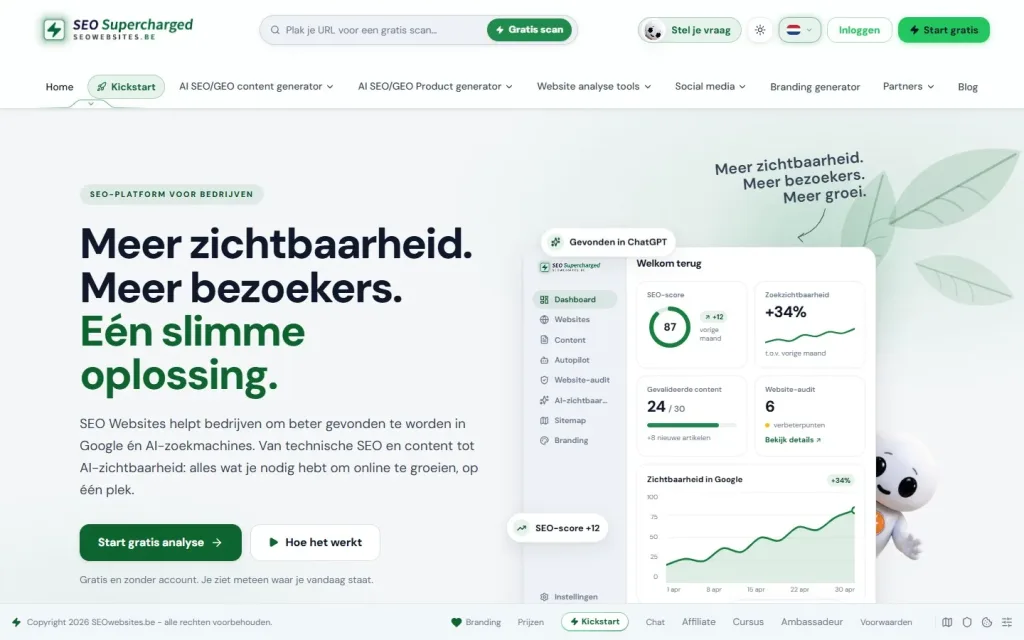
SEO Websites
My own SaaS platform for website analysis, SEO content and visibility in search engines and AI systems.
- React
- Node.js
- Express
- Claude

React & Next.js · E-commerce · Organic Web
Pelletkachelzorg
My own commerce platform in React and Next.js for the sale, installation and servicing of stoves, in four languages.
- React
- Next.js
- Claude
- GPT
How I work
How a GEO project works
As a one-off audit or as a project with follow-up. Monitoring can be part of the project or agreed separately. There is no mandatory monthly plan.
A single change rarely produces an immediate mention: AI systems process new information at their own pace.
01
Measure
A baseline before anything changes: how your brand, your services and your competitors appear today in search engines and AI answers.
02
Structure
Getting the entity, content architecture and technical foundation in order.
03
Improve
Working on content, structured data, sources and internal links.
04
Publish
Adding new citable pages and knowledge content where they are missing.
05
Check
Testing the same relevant questions again after implementation, and comparing recognition, sources and answers with the baseline.
Expectations
What GEO is not
- piling up keywords for ChatGPT
- uploading an llms.txt file and calling it done
- publishing dozens of AI articles a day
- installing schema markup and calling it done
- a guarantee of mentions
- a paid placement in ChatGPT
What I do instead: increase the chance that AI systems recognise and cite your brand correctly, and make that measurable.
Pricing
How much do GEO and AI SEO cost?
The price of GEO and AI SEO depends on what is already in place and what needs to be done. After an initial analysis, I can define the scope and price in concrete terms. These factors determine the size of the job.
- Technical foundation How well the website can be crawled and read today.
- Entity issues How much confusion there is around your name, your brand and your details.
- Amount of content How many pages need to be rewritten or added.
- Services and markets Each service, language and region requires its own work.
- Presence in external sources Where you are already mentioned today, and where you are not.
- Existing SEO A strong SEO foundation reduces the GEO work.
- Implementation How many of the changes I implement in the website myself.
Why Dries
One person for code, content and entity
- Direct contact You work with the person who measures, writes and builds, with no account manager in between.
- Development and visibility I adjust templates, structured data and rendering in the website myself.
- Measure first I start from how you appear today, not from assumptions.
- No promises about mentions I tell you what I can improve and what is beyond anyone’s control.
About the specialist
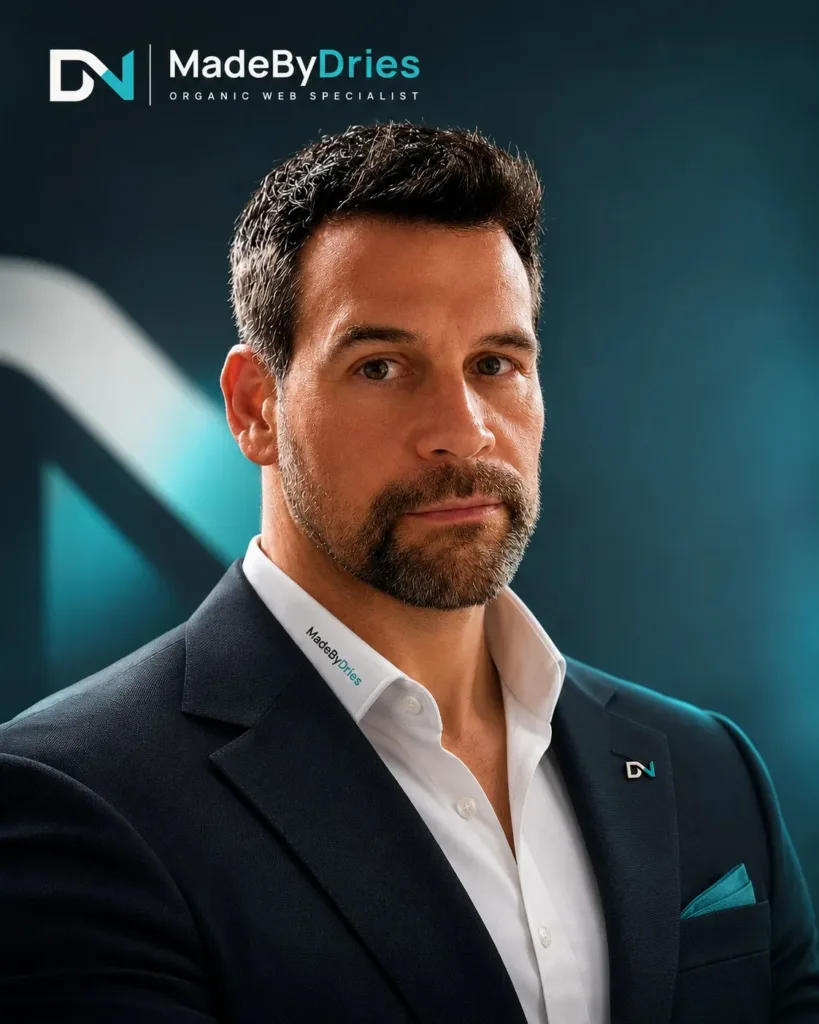
Dries Nijs, Organic Web Specialist
I am Dries Nijs, an Organic Web Specialist from Maasmechelen. I combine web development, technical SEO, content architecture, structured data and GEO. I have been building websites since the 1990s. The fact that AI systems now read along changes the fundamentals less than it might seem. MadeByDries is the personal brand under which I work.
FAQ
Frequently asked questions about GEO and AI SEO
What is GEO?
GEO stands for Generative Engine Optimization: building a brand and its content in such a way that generative AI systems understand them and can cite them. In Belgium, “geo” also has other meanings, such as geographical data. Here it refers to visibility in AI answers.
What is AI SEO?
AI SEO is another name for the same work as GEO: making your website and your brand discoverable and citable for AI systems. The term is also used for SEO work carried out with AI tools. On this page, I mean the former.
Is GEO the same as SEO?
No, but they overlap considerably. SEO focuses on the traditional search results, GEO on the answers that AI systems compose. Both require good content, sound technology and authority. GEO does not replace SEO: it builds on it.
How do you become visible in ChatGPT?
By making sure ChatGPT can find, read and trust you. That requires a website that allows crawlers, clear information about who you are and what you do, answers to your customers’ questions and mentions in sources the system consults. You cannot sign up for a place in the organic answers. The step-by-step plan is in Becoming visible in ChatGPT.
Can I optimise for Google AI Overviews?
You can increase the chances, not determine the outcome. According to Google, the same requirements apply to AI Overviews as to the regular search results: a page must be indexed and offer useful content. Clear answers, a clear structure and structured data help. Whether a page is cited is Google’s decision.
What is AEO?
AEO (Answer Engine Optimization) means optimising for systems that give a direct answer. It largely overlaps with GEO. On its own, “AEO” is also a customs term in Belgium. That is not what this is about.
Is llms.txt useful?
Only to a limited extent. llms.txt is a proposal for a file that gives AI systems a readable overview of your website. It takes little effort, but it is not an official standard and does not guarantee mentions. It does not replace a strong website, good content or clear entities.
Can you guarantee that ChatGPT will mention my business?
No. AI systems are run by external companies, their answers vary by question and over time, and no specialist has control over that. What I can do is increase the chance that your brand is correctly recognised and cited, and monitor that with a fixed set of questions.
Curious how AI systems see your business today?
Tell me which services and search queries matter to you, and where you are or are not mentioned today.